This site uses cookies to store information on your computer. By using this site, you consent to the placement and use of these cookies. Read our Privacy Policy to learn more.
ACCEPT
“I feel pretty good! I feel super today!” said Caroline Darienzo. She hit the century mark and was surrounded by family and friends at the Nativity of the Blessed Virgin Mary Church in Ozone Park, Queens. That’s where Caroline goes to Mass every Sunday. Before the party, Caroline and friends were in church for a special birthday liturgy and a request. “I tell Him to look over me and He has,” said Caroline.
The thing Caroline cherishes most about her life is spending time with family. Though she’s a widow and never had children, Caroline has dozens of nephews and nieces. She’s even a great-great aunt. While we were talking, Caroline received a surprise from some of them. “Oh my gosh! These… these are… my relatives from Florida!” said Caroline. Her nephew, niece and great-nephew made the trip to be with her on this special day. “It was great! We had been planning this for a couple of months. We were scared that she couldn’t take it, being that her heart is 100 years old,” said Fred Distasio jokingly. He is Caroline’s nephew.
Caroline is the oldest of six children. Her youngest and only living sibling is 82-year-old Marie Francione. “She was like my second mother growing up. She used to take me shopping. She was the first one to make me get a permanent wave hair style, even though I hated it,” said Marie as she smiled. Caroline was born in Jamaica, Queens in 1919 and had a career in the oil industry. Now retired for nearly four decades, she loves sewing and cooking. She even busted a move on the dance floor.
Caroline had some tips about living a long life, “Laugh. Joy. Eat. And be merry.” And that she was — on her 100th birthday.
Catholic schools are widely recognized as the best in New York City. Now, bureaucrats in Albany want to put them under the thumb of public-school authorities – and that would make a big difference for students at Xavier High School.
Student William Shelton said “Xavier has individuals in positions of authority that care that they want you to grow.”
“The religion aspect for me is usually the best part,” said Patrick Scariano, another student at the school.
Arthur Gange added “It’s always been my favorite subject but Xavier has done more than enough to make me love the subject even more.”
The New York State Education Department issued a new set of rules that would subject all nonpublic schools – including Catholic institutions – to so-called evaluation by public school officials.
Michael Livigni is Xavier’s Headmaster and he added, “Our schools are not the problem so I think instead of taking on the schools that are a problem, the education department is creating a blanket rule that doesn’t make much sense.”
The State is justifying public overseers in Catholic schools by saying the outsiders would be able to intervene if a complaint is made about a nonpublic school.
Xavier’s President Jack Raslowsky says that move is unwarranted, adding “There’s rules and regulations and law now to allow them to respond adequately to complaints. And this extra layer of call it what you will, interference, oversight, is just unnecessary.”
And at the same time, the city’s public school system is facing its own challenges.
A week ago, state Senators warned Mayor Bill De Blasio to get better control of discipline in the classroom if he wanted to retain his control of the city’s public schools.
Xavier is well-known for its academic excellence.
Last year, 99 percent of graduating students went on to 4-year colleges.
Right now, New York’s Catholic Conference of schools is supporting a court action to block the Education Department’s implementation of the new rules.
The regulations could impact 192 religious and private institutions statewide if put in place.
“The independence and the roots of our faith, have strengthened us and allowed us to do great work,” said Raslowsky.
Livigni adding, “We cover whatever New York State says and suggests we should, we just do it in a way that’s tried and true for almost 500 years.”
The next step in the court case will come at a hearing on March 29th.
For more about the Catholic Academies, parish schools and high schools in the Brooklyn Diocese visit catholicschoolbq.org. The website has information about admissions, financial aid, and a lot more.
We did reach out to the New York State Education Department for comment on this story, but, so far, they haven’t responded.
Cardinal Pell continues to proclaim his innocence and will try to appeal the verdict. June 5th & 6th have been set as dates to consider the basis for the appeal.
“I just have to assume that the overall atmosphere in Australia, the sort of toxic atmosphere, in which Cardinal Pell has sort of been made a scapegoat – for the problems of the Catholic Church over these past decades – was at play in this verdict,” said Miscamble.
Catholic high school students at Sacred Heart Academy in Hempstead, Long Island are receiving a prestigious honor — the opportunity to present their psychology research at an international conference. “It’s really exciting to go. It’s a really competitive place to be,” said Caroline Doran, a senior at the all-girls Catholic high school.
A dozen students will join hundreds of other presenters in Washington D.C. this Spring. It’s an annual convention organized by the Association of Psychological Science. But what makes these stellar students stand out — they’re in high school. Throughout the conference’s 30-year history, very few presenters their age had the same opportunity. “I think it’s going to be a really good experience. I think it’s going to be really cool to be the youngest people there because it’s going to be fun to see people say, ‘wow, I can’t believe you’re here!” said Grace Doran, another Sacred Heart Academy senior. “Standing next our 17-and-18-year-olds will be a Princeton undergraduate, a Western Kentucky grad student, and the occasional assistant professor,” said Doctor Stephen Sullivan. He oversaw their projects and says the students achieved years-worth of research in six months.
They’ll present a variety of topics, like how Hurricane Maria impacted high school students in Puerto Rico. The category-five storm ripped apart the U.S. territory last year. The Long Island students surveyed nearly 200 teenagers attending their sister school in San Juan. “More than 50 percent answered, ‘yes, I did see someone else get badly injured;’ or ‘yes, I did struggle to find food;’ or ‘yes, I had to move away from friends,” said Claire Carney. She is a senior at Sacred Heart and worked on the project.
Other topics range from students’ anxiety levels when teachers use red ink to grade tests and how students participate in extracurricular activities if they live in diverse neighborhoods.
The high school seniors credit their faith-based education for achieving the high honor. “Going to catholic school has made all the difference for me. I think it completely changes your high school experience. I think it gives you a really great foundation,” said Grace Doran.
The international conference is scheduled for the end of May.
On the newscast: Cardinal George Pell insists he is innocent after being sentenced on sexual abuse allegations. There are serious questions about the case; Pope Francis’ sixth anniversary and the scandal challenge. An exclusive report; President Trump puts out an emergency order about those Boeing jetliners after the latest crash; A new example of Catholic education’s excellence as high school students receive a rare honor.
Today’s top news from the Catholic perspective anchored by Liz Faublas. Currents News airs Monday through Friday at 7:00 p.m. ET on NET-TV (netny.tv)
A sentence handed down on live tv by Chief Judge Peter Kidd of the County Court of Victoria.
Judge Kidd said, “I am conscious of the heavy reality that I am about to sentence you, a man of advanced years, who has led an otherwise blameless life to a significant period of imprisonment.”
Australian Judge Peter Kidd speaking before issuing a six-year prison sentence to Cardinal Pell.
Once a top aide to Pope Francis, the Cardinal was convicted in December on allegations he abused minors in 1996 when he was Archbishop of Melbourne.
The guilty verdict came during a re-trial of the accusations. The first trial ended in a hung jury.
Throughout both proceedings, Cardinal Pell has insisted he’s innocent. He’s appealing the conviction and Australia’s Supreme Court has put that appeal on a fast-track.
The case will be back in court this June.
A number of legal experts have raised questions about the Pell verdict.
In a column published in the current edition of the Tablet, noted Catholic writer George Weigel, called the charges against Cardinal Pell a quote, “…travesty of justice, thanks in part to a public atmosphere of hysterical anti-Catholicism – a fetid climate that had a devastating impact on the possibility of his receiving a fair trial.”
The sentencing judge turned the Cardinal’s insistence that he’s not guilty into a strike against him. He explained, “You maintain your innocents in relation to this offending which is your right but as a consequence there is no evidence of your remorse or contrition for me to act upon to reduce your sentence.”
After the sentence was imposed, the father of an alleged victim who died of a drug overdose said the sentence should have been longer. He said, “I was hoping 20 years and I thought realistically maybe 10? 6, well, I don’t think that is sufficient. Especially when you think the minimum is going to be three and a half.” He has not been named for legal reasons.
By Christopher White, The Tablet’s National Correspondent
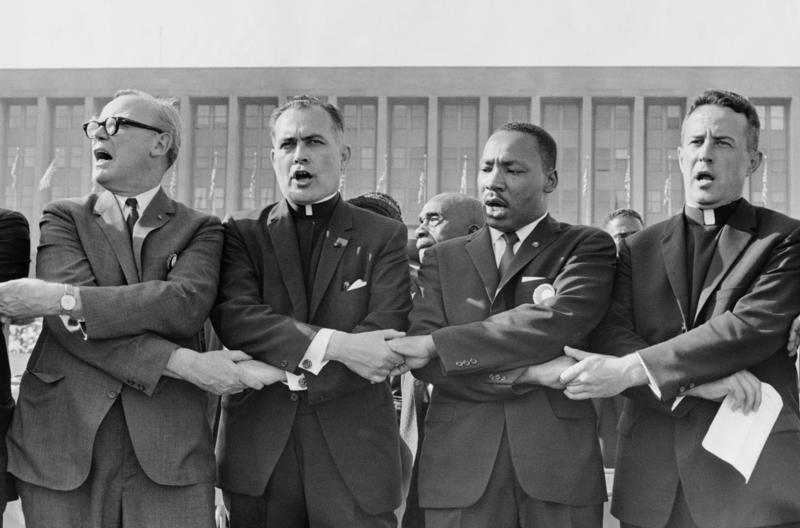
Holy Cross Father Theodore Hesburgh, second from left, joins hands with with the Rev. Martin Luther King Jr., the Rev. Edgar Chandler and Msgr. Robert J. Hagarty of Chicago, far right, in this 1964 file photo. Father Hesburgh, then president of the University of Notre Dame, convened the group that produced the 1967 Land O’ Lakes statement. (CNS photo/courtesy University of Notre Dame)
NEW YORK – Few priests manage to land on the cover of Time magazine, but Father Ted Hesburgh was no ordinary priest.
For thirty-five years, Father Hesburgh served as president of the University of Notre Dame, where he became friends with popes and presidents alike. He would go on to march alongside civil rights crusader, Dr. Martin Luther King, Jr., and later become a leading voice for economic development in the third world.
In a new biography out on Tuesday, American Priest: The Ambitious Life and the Conflicted Legacy of Notre Dame’s Father Ted Hesburgh, Notre Dame historian Father Wilson Miscamble, chronicles the life and legacy of Father Hesburgh. While the two developed a steadfast friendship, it was challenged by competing understandings of Catholic higher education and decisions Father Hesburgh made during his tenure at the university.
In an interview with The Tablet, Father Miscamble discusses Father Hesburgh’s consequential decisions at Notre Dame and the challenges of being fully American and fully Catholic.
The Tablet: Notre Dame is considered one of, if not the premier institution of Catholic higher education in the United States, yet its Catholic identity is often the subject of vigorous debate. Why is that the case and what role does Hesburgh’s legacy factor into these debates?
Father Miscamble:In my book, American Priest: The Ambitious Life and Conflicted Legacy of Father Ted Hesburgh,I reveal how Notre Dame’s legendary president sought the respect of the secular academic establishment. He worked in light of its criteria, rather than those unique to a Catholic university. He emphasized “excellence,” but it was an excellence as defined by the secular institutions. As a consequence, Notre Dame has wrestled with issues of Catholic identity since Father Hesburgh’s time.
From Eisenhower to Clinton, Father Hesburgh was an ally or at least influential figure, for numerous presidential administrations. How did he manage to serve such a role – and maintain it for so long?
Father Hesburgh saw himself as a true American patriot and he held strongly that the United States possessed a special and God-given destiny. He loved this country and had a special regard for the office of the presidency. He felt a deep obligation to respond if called upon by an American president, and he was very glad to serve presidents from Eisenhower through to Clinton.
His role was, however, not one of a spiritual guide or religious counselor to these presidents in the manner of Billy Graham. Instead, he toiled tirelessly to aid the United States in resolving some of the major issues and challenges it confronted during these challenging decades from the 1950s through the 1990s. He held a number of special appointments that involved him on a range of issues; the most important by far was his service on the Civil Rights Commission from 1957 until 1972.
How did Father Hesburgh forge such a close friendship with Pope Paul VI – and what was his own personal response to Humanae Vitae?
Father Hesburgh served a number of popes through his role as Vatican delegate to the International Atomic Energy Agency, but he enjoyed a close personal friendship with Paul VI -at least for a time. They established their friendship when the then-Cardinal Montini visited Notre Dame in 1960 for the commencement exercises. A real bond was established between them and this continued once Montini was elevated to the Chair of Peter. Father Hesburgh had easy access to the pope and discussed a range of issues with him, including matters related to Catholic higher education.
At the request of Paul VI, he took the lead role in developing the Ecumenical Institute at Tantur in the Holy Land. It was undoubtedly a sadness for both men when their friendship ruptured in 1968. Father Hesburgh was surprised and disappointed with Pope Paul VI’s encyclical Humanae Vitae, but he made no public criticism. The rupture in their relationship came when Hesburgh endorsed criticisms of the Vatican made by Cardinal Leo Suenens of Belgium. Paul VI apparently was hurt by these criticisms and the fracture in the relationship was never fully repaired. The brotherly connection they had once shared could not be restored.
Did the university’s decision to award President Barack Obama with an honorary doctorate in 2009, which you were widely considered to be one of the leaders of the opposition to, prove to be irreparable for your friendship with Hesburgh?
Father Hesburgh and I maintained our friendship right through until his death, but our contact certainly diminished as our views regarding the direction of Notre Dame diverged in the final decade or so of his life. He found particularly troubling my public criticisms of the honoring of President Barack Obama by Notre Dame in 2009. While I spoke at a protest rally on that commencement day, Father Ted basked in the glory of praise from the nation’s president. Thereafter, I kept our occasional conversations rather light and away from controversial topics when I saw him at my order’s retirement home, to which he had moved in 2005. I had no desire to upset or to argue with him.
As you look back on Hesburgh’s legacy at Notre Dame, if you could reverse only one of his decisions, which would it be?
I prefer to answer this question by identifying a couple of broad areas where I have regrets about actions Father Hesburgh either took or failed to take.
It is because of my high regard for Father Hesburgh and his capabilities that I have regrets in the more general sphere that he did not give the same energy and commitment to the pro-life movement after Roe v. Wadethat he gave to his civil rights efforts during his service on the Civil Rights Commission. I know that this would have involved him in challenging some of the groups and individuals with whom he had become involved, like the Rockefeller Foundation. He could have played a valuable role in this crucial area.
Father Hesburgh never achieved his grand goal of constructing a great Catholic university because he never developed a strategy that identified and developed the means to secure that good end. While he surely did his part to raise the finances and to erect the buildings to fulfill his goal, he never gave sufficient attention to the crucial areas of faculty hiring and curriculum content. He failed to address effectively the crucial issues at the heart of a university – namely, who teaches and what is taught. His desire that Notre Dame fit comfortably into the American academic milieu and that it win the respect of the leading secular universities won out. I regret that he succumbed too much to the pressures to conform in the central academic domain of the university.
Hesburgh was both fully American and fully Catholic. In today’s political climate, many Catholics find those two stances in tension. How do you think Hesburgh would navigate our current political moment?
As I said above, Hesburgh had a deep love for the United States, and of course his whole life was tied up with his service as a priest. He viewed the United States as a work in progress and it remained for him always “the most exciting human experiment in the world.” Father Ted never acknowledged that there might be significant tensions involved in his serving both his church and his nation. Even when he got caught increasingly in the embrace of the secular, liberal establishment – especially through his membership on the board of the Rockefeller Foundation – he never questioned the range of his public involvements. But perhaps membership in this establishment exacted a painful price for him.
Far from shaping public attitudes in key areas in America, where his voice might have made a difference, he increasingly either reflected the American liberal political and social agenda or he downplayed the areas where he dissented from it. In the end, perhaps it might have been better if Father Ted had recognized that it is sometimes challenging to be both fully Catholic and fully American.
Six years ago, today, Francis turned heads as the first pontiff to take St. Francis’ name, the only Jesuit pontiff and the first one from Latin America.
This white smoke signified a historic moment for the Catholic Church.
The current Vatican Spokesperson gives his first impressions on that day.
“Thinking back to the 13th of March six years ago, the first impression that comes to me is amazement, surprise,” said Alessandro Gisotti.
This surprise was seen and continues by Pope Francis’ unexpected messages and gestures.
“How I would like a Church that is poor and for the poor!” said Francis on March 16, 2013.
In addition to caring for the poor, is his passion for welcoming refugees. After visiting a refugee camp in Greece, he brought several Muslim families with him to Rome.
“It would move you to tears. What have these children seen? Look at this,” he said about a month later.
Pope Francis has carried out reforms, both in the Curia and in ages-old mentalities. He’s encouraged Christian initiatives to solve issues such as youth Church involvement to care of the environment.
However, the main challenge for him has been the Church’s sexual abuse crisis.
“His commitment for peace, for dialogue, and especially his commitment to confront the scourge, the terrible scourge of abuse of minors. I think that this is an example for everyone of us,” said Gisotti.
With all this, he hasn’t slowed down in his travels, with upcoming trips to Morocco, Macedonia, Bulgaria, Romania and perhaps Japan this year alone.
Pope Francis predicted a short pontificate, but in comparison to Urban 7th who was pope for 13 days and Pius 9th with 31 years, we’ll have to see just how long he’ll remain as head of the Catholic Church.
On the newscast: In the aftermath of that deadly Ethiopian Airlines crash, we’re learning more about the Catholic Relief Services workers who lost their lives serving God. Meanwhile, the plane involved – the Boeing 737 Max 8 – is being grounded in a growing list of countries, but not the U.S.; The feds are calling it the largest college admissions scam they’ve ever prosecuted- elite schools and Hollywood actresses are caught up in the scandal.
Today’s top news from the Catholic perspective anchored by Liz Faublas. Currents News airs Monday through Friday at 7:00 p.m. ET on NET-TV (netny.tv)