Iranian Leader Killed in Baghdad Rocket Attack

Currents News Staff

The Iranian National Security council is holding an urgent session Friday, Jan 3. This comes in the aftermath of the U.S. taking responsibility for an attack that killed two Iranian officials – one of whom was the commander of the country’s Islamic revolutionary guards Quds force.

President Trump tweeted an image of the American flag without comment Thursday night. But the Pentagon confirms the President ordered the strike that killed Qasem Soleimani, the commander of Iran’s Quds force.

“My question to the Americans is ‘What’s your plan for keeping Iraq stable after pulling this off?’”, said Feisal Istrabadi of the Center for the Study of the Middle East at Indiana University.

According to a Pentagon statement, the U.S. took “decisive defensive action to protect U.S. personnel abroad” by killing Soleimani.

Democrats expressed concern about legalities of the strike. “Obviously we need to do what’s necessary to protect the lives of Americans but unfortunately actions this administration has taken for weeks and months now have taken a difficult situation and made it much worse,” said Sen. Chris Van Hollen from Maryland.

Republicans heaped praise on President Trump. Lindsey Graham tweeted “I appreciate President Donald Trump’s bold action against Iranian aggression. To the Iranian government: if you want more, you will get more.”

The Foreign Minister of the Islamic Republic of Iran tweeted the attack was “extremely dangerous and a foolish escalation.” and that “the U.S. Bears responsibility for all consequences.”

“This is a direct action between the United States against a senior military commander of Iran. It’s isn’t a proxy war anymore,” said Istrabadi.

Currents News for Thursday, January 2, 2020

On the newscast: Pope Francis apologizes after an incident in Saint Peter’s Square on New Year’s Eve; More anti-Semitic attacks and a very powerful message from the daughter of a machete attack victim who is still in a coma; The field thins out as Julian Castro calls it quits in the race for the White House – the other candidates taking Iowa by storm;   And celebrating Haitian Independence Day with a mass in Brooklyn.

Watch weeknights at 7:00 pm EST on NET-TV in the New York City area on Spectrum, Optimum, and Fios. Subscribe to our YouTube channel to receive notifications about new content.

New Year’s Day Attack Adds to Spree of Anti-Semitic Violence

By Christopher White and Emily Drooby

NEW YORK — New Year’s Day began with yet another local anti-Semitic attack, when a 22-year-old Hasidic man was beaten and subjected to hate speech in Williamsburg — the 13th known attack against Jews in the New York area in less than 10 days.

The violence on Jan. 1 followed the Hanukah attack at the home of a rabbi in Monsey, N.Y., where five people were stabbed in an incident that Gov. Andrew Cuomo labeled as “domestic terrorism.”

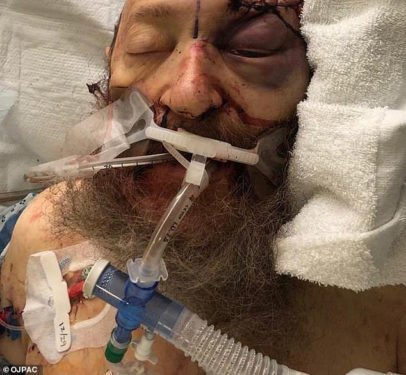
Family members of one of the victims of that attack, Josef Neumann, released a graphic photo on Jan. 1 of the father of seven children hooked up to respirators and stitched up from the multiple stab wounds he incurred. Doctors expect Neumann to be permanently paralyzed and are unsure if he will ever regain consciousness.

Josef Neumann (Photo: OJPAC)

In response to the heinous attack, Bishop Nicholas DiMarzio said, “Hate like this has no place in a civil society.”

“Today we are reminded it is better to light one candle than to curse the darkness. Let us be that light as we pray for peace and practice tolerance today and always,” Bishop DiMarzio continued in a statement.

Bishop DiMarzio also joined more than 130 faith leaders from across the state, including New York Cardinal Timothy Dolan, to condemn the attack.

“Anti-Semitism, bigotry and hate of any kind are repugnant to our values and will not be tolerated in our state,” they said. “An attack against one of us is an attack against all of us. Together we will continue fighting hate and intolerance with love and inclusion.”

The recent attacks in New York come at a time when people of faith are facing increased violence at houses of worship across the nation.

According to the latest data from the Federal Bureau of Investigations, hate crimes in churches, synagogues, temples and mosques have risen 34.8 percent between 2014 and 2018.

On Dec. 29, in Texas, a gunman fatally shot two churchgoers at West Freeway Church of Christ in White Settlement, before being killed by a security guard on-site.

The past year proved particularly deadly for people of all faiths across the globe. Incidents included the Easter Day massacres in Sri Lanka that killed more than 250 people and attacks at two mosques in Christchurch, New Zealand, last March that killed 51 individuals.

In recent days, New York has ramped up security around houses of worship, and the governor has ordered increased patrolling efforts in Orthodox Jewish neighborhoods throughout the state.

On New Year’s Day, Cuomo visited Williamsburg to stand in solidarity with the community there.

“The Jewish community is very important to me personally. It’s been very important to my family for many years,” Cuomo said.

“Everybody feels very upset and disturbed about what happened and everybody stands in solidarity with you,” he continued. “So I’m here today, not just for me, I’m here representing all the people of the state of New York who want to say they’re sorry about the tragedy, and they stand with you in total solidarity and love, because that’s what we are.”

Pope Opens New Year with Strong Condemnation of Violence Against Women

By Elise Harris

ROME (Crux) – Pope Francis began 2020 with a bang Wednesday, issuing a harsh condemnation of violence against women and insisting that how society treats women and their bodies is a measure of its level of humanity.

In a special Mass marking the Catholic Church’s Jan. 1 feast celebrating Mary, Mother of God, the pope noted that in God’s plan of salvation, “The rebirth of humanity began with a woman.”

“From her, woman, salvation arose and therefore there is no salvation without the woman…Women are sources of life,” he said. “Yet they are continually offended, beaten, raped, forced into prostitution and forced to suppress the lives they carry in their wombs.”

“Every violence inflicted on women is a profanation of God, born of a woman. Humanity’s salvation came from the body of a woman: By how we treat a woman’s body, we can understand our level of humanity,” the pope said.

He condemned the frequent “sacrifice” of a woman’s body on “the profane altars” of profit-making industries such as advertising and pornography. A woman’s body “must be freed from consumerism, it must be respected and honored,” he said, calling it “the noblest flesh in the world, it conceived and gave birth to the love that saved us!”

Motherhood is also often “humiliated,” he said, “because the only growth that draws interest is that of the economy.”

“There are mothers who risk perilous journeys to try desperately to give the fruit of their wombs a better future,” yet they are dismissed “by people who have a full belly, but of things, and a heart devoid of love.”

This is not the first time Francis has spoken out on behalf of women. Violence against women is a cause he has taken to heart, issuing frequent condemnations of pornography, forced abortions, and forced prostitution, which many women, specifically victims of human trafficking, endure.

He has also corresponded with women who have suffered domestic violence, including an Italian mother named Filomena Lamberti, whose face was disfigured when her husband threw acid on her.

One of the most recent examples of the pope’s attention to the cause was given by Mexican journalist Valentina Alazraki, who in the January 2020 edition of Donna, Chiesa, Mondo, a monthly women’s supplement to the Vatican newspaper L’Osservatore Romano, recounted words the pope shared with her on the topic during an interview.

Alazraki, who has interviewed Francis twice, penned an article for the supplement dedicated to violence against women in which she tells the story of Rocio, a 27-year-old mother of three who was killed in Mexico in front of her 8-year-old son after accidentally overhearing drug traffickers discuss their plans while eating at the restaurant Rocio worked at.

Alazraki, who has written a book about violence against women, was given the shirt Rocio wore the day she died by Rocio’s son. She brought the shirt with her to her interview with the pope, and, upon hearing Rocio’s story, the pope became emotional, she said.

Once the interview was over, Francis picked up the shirt and uttered a prayer for Rocio, calling her blouse “a flag of the suffering of so many women who give life and pass by without a name. We know the name of Rocio…but of many others no. They pass without leaving their name but a seed.”

This seed, he said, according to Alazraki, must be “an awareness of all this.”

In his homily Wednesday, Francis urged Catholics to imitate Mary and questioned them on their attitude toward others, including those closest to them, insisting that Mary helps to overcome indifference and to foster unity.

The devil, Francis said, tries to divide the Church by “putting in first place, differences, ideologies, parties and partisan thoughts. But we do not understand the Church if we look at it starting with structures, programs and trends: We will take something from it, but not the heart. Because the Church has the heart of a mother.”

Francis closed his homily praying that as the new year begins, Christians would live it “with the desire to take others to heart, to take care of others.”

“If we want a better world, that it be a house of peace and not of war, at the heart is the dignity of every woman. From woman the Prince of Peace was born. The woman is the donor and mediator of peace,” he said, insisting that women “must be fully associated with decision-making processes.”

When women are able to share their gifts, he said, “the world finds itself more united and more peaceful. Therefore, an achievement for women is an achievement for all of humanity.”

Haitian Independence Day Celebrated Throughout Diocese

By Jessica Easthope

Ringing in the New Year is a tradition celebrated by all – but for the Haitian community, January 1st means independence.

Every year a Haitian Independence Day Mass is held at a different church in the diocese. This year the Mass was celebrated at Holy Family Parish in Canarsie.

Though the Mass is a joyous occasion, the faithful in attendance were quick to speak about a timely and solemn issue that is on the minds of Haitians this holiday.

Gaelle Prussien comes every year with her family to the Mass. “The majority of Haitians who come to the United States are coming for a better life and Haiti right now is in turmoil,” Prussien said.

Bishop Nicholas DiMarzio has been celebrating the Haitian Independence Day Mass for the last 15 years. “We also pray for the immigrants especially those dealing with TPS try and get them some permanent status, the political situation is unstable so we try to help whoever we can,” said Brooklyn’s Bishop.

Temporary Protected Status, or TPS, has been extended to January 4, 2021; however, pending further court decision in 2020, that could be the last date Haitians are protected from deportation back to Haiti which is dealing with political corruption and the continued aftermath of the 2010 earthquake that devastated the island nation.

Despite the stress of uncertainty, celebrating independence was a priority. After Mass, hundreds poured into Holy Family’s gymnasium for a feast.

Guests sat at red, white and blue tables decorated with Haitian flags and enjoyed soup joumou, a traditional Haitian food that’s eaten on Independence Day every year.

“They could not have the soup and when they became free that was their liberty and the way to show their independence,” said Marie Guelda Bericles, who helped prepare the soup.

As 2020 begins, church leaders are working to maintain a safe place for Haitian immigrants and those who need most to be welcomed into the country with open arms.

Global Hot Spots Spark Challenges for U.S. in 2020

Currents News Staff

As we clean up the confetti ushering in the new year, President Trump ushers in a new trade deal with China.

“We are very excited about trade. The China Deal will be signed probably on January 15th. We put out a notice today and I will be going at some point to Beijing to be with President Xi,” said Trump.

That trip will come in the midst of ongoing anti-government protests in Hong Kong.

Meanwhile, a spokesperson for the protesters outside the U.S. embassy in Iraq say they’ve asked everyone to withdraw Wednesday.

U.S. Special Representative for Iran Brian Hook says it comes after strong leadership from the Trump administration.

“Secretary Pompeo is in pretty regular touch with the Iraqi leadership // So we’re pleased that the Iraqi security services have come in and done what is necessary and so our diplomats are safe and so is our embassy,” said Hook.

Another international place of tension is North Korea, where leader Kim Jong Un says promises made at their summit last year aren’t being kept – and he’s now threatening new strategic weapons.

“He made those commitments to President Trump agreeing not to conduct large scale military exercises. We’ve lived up to our agreements. We continue to hold out hope that he’ll live up to his as well,” said Pompeo.

Back at home, the pending Senate impeachment trial also looms over President Trump and lawmakers.

Currents News for Monday, December 23, 2019

On the newscast: Pope Francis is warning that Christianity is declining and reform is needed right now; The holiday stalemate over the Senate impeachment trial – takes a turn. Democrats now say newly released emails make it necessary for White House witnesses to testify; Boeing’s chief executive is fired over the company’s handling of the 737 Max jet crisis. And weather headaches kick off Christmas travel on the roads and in the air.

Watch weeknights at 7:00 pm EST on NET-TV in the New York City area on Spectrum, Optimum, and Fios. Subscribe to our YouTube channel to receive notifications about new content.

Pope’s Annual End of the Year Speech

Currents News Staff

In his annual end of the year speech to the Roman Curia, Pope Francis discussed his decision to limit the term of the dean of the College of Cardinals. The influential position is one that had previously been held for life.

He also acknowledged that Christianity no longer holds the commanding presence and influence in society that it once did. 

The pontiff’s message appears to be aimed at conservative and traditionalist Catholics, who have voiced opposition to his progressive minded papacy. 

Joining Currents News to discuss the impact this change has as the Church moves forward is John Allen, Editor-in-Chief of Crux, in Rome.

Pope Francis Celebrates Christmas Season With Youth

Currents News Staff

Pope Francis met with children and their families who receive medical aid from the Santa Marta Dispensary. 

The dispensary is inside the Vatican and has provided medical assistance to families in need for over 90 years. 

The pontiff thanked the parents and volunteers for bringing joy to children’s lives.

“Bringing joy to children is a very great thing,” Pope Francis said.

 “Even parents who know how to play with children do a very great thing. To play with children, playing is the expression of children, who are innocence, promise, so many good things.”

He then addressed the children directly, reminding them of the need for hope, love and peace.

The Holy Father had a big smile on his face as he listened attentively to a children’s choir.

There were even some acrobatic performances, with one dancer on stilts, dressed as an angel with lights all over her costume.

There was also a living Nativity scene with the children playing the different characters.

Then a group of workers and children wheeled out a cake to celebrate Pope Francis’s eighty-third birthday.

Better late than never.

‘Christendom No Longer Exists,’ Pope Says, Explaining Need to Revamp Curia

VATICAN CITY (CNS) — The ongoing reform of the Roman Curia is a necessary part of the Catholic Church’s fidelity to its mission to proclaim the Gospel, recognizing that very few countries today can be described as “Christian” and that new ways of evangelizing are necessary, Pope Francis said.

But attempts to meet the new challenges are threatened by “the temptation of assume an attitude of rigidity,” the pope said Dec. 21 during his traditional pre-Christmas meeting with cardinals and top officials of Vatican offices.

“Rigidity, which is born of the fear of change, ends up erecting fences and obstacles on the terrain of the common good, turning it into a minefield of incomprehension and of hatred,” the pope said. “And today this temptation of rigidity has become very evident.”

Pope Francis quoted from St. John Henry Newman, whom he canonized in October: “To live is to change, and to be perfect is to have changed often.”

“Obviously,” the pope said, “it’s not about seeking change for change’s sake or about following fashions, but of having the conviction that development and growth are characteristic of earthly and human life while, from a believer’s perspective, at the center of everything there is the stability of God.”

“For Newman,” he said, “change was conversion, that is, an interior transformation,” which clearly shows that the Christian life is a pilgrimage, a process of moving closer to God.

Conversion and transformation are part of an individual’s response to God’s call, but also must take place within the Curia, which is called to be at the service of the church in its efforts to share the Gospel, he said.

Looking specifically at the Curia reform process and the planned reorganization of Vatican offices according to the draft constitution, “Praedicate Evangelium,” (“Preach the Gospel”), Pope Francis addressed the question of merging the Congregation for the Evangelization of Peoples with the Pontifical Council for Promoting New Evangelization and placing the office ahead of the Congregation for the Doctrine of the Faith on the Vatican’s organizational chart.

But first he told the cardinals and top Curia officials that the church engages with the changing world “anchored principally on fidelity to the deposit of faith and tradition.”

The Curia reform project, he said, “has never had the presumption of acting as if nothing existed before; on the contrary, it focused on valuing what good was done” and on preserving its “roots” so that it can be fruitful.

“Invoking memory does not mean grasping on to self-preservation, but recalling the life and vitality of a process in continual development,” he said. “Memory is not static, it’s dynamic. By its nature it implies movement.”

As he has often done, Pope Francis quoted the 19th-century composer Gustav Mahler, who said, “Tradition is not the worship of ashes, but the preservation of fire.”

The pope discussed the changes proposed for the doctrinal congregation and the Congregation for the Evangelization of Peoples, the large Curia office that supports and oversees church efforts in lands traditionally known as “missionary territory” — like Africa and Asia.

The two congregations, he said, were instituted “in an age when it was easier to distinguish between two fairly well-defined shores: a Christian world on one side and a world still to be evangelized on the other.”

“This situation no longer exists,” the pope said.

“In fact,” he said, “the populations that still have not received the proclamation of the Gospel do not live only on non-Western continents, but live everywhere, especially in the large urban concentrations, which require their own specific pastoral work.”

“Christendom no longer exists,” he said. “Today we are not the only ones who produce culture, nor are we the first or the most listened to.”

Christianity, “especially in Europe, but also in a large part of the West, is no longer an obvious premise of our common life, but rather it is often denied, derided, marginalized or ridiculed.”

Evangelization and the “new evangelization” St. John Paul II called for are urgent needs, the pope said, which is why the Curia itself must change and adapt.

Pope Francis told the Curia officials there are and will be challenges and complications “for the simple fact that between a glorious past and a creative future on the move, we find the present in which there are people who necessarily need time to mature,” and there are “juridical and institutional questions that must be resolved gradually, without magic formulas or shortcuts.”

The pope also spoke about the Dicastery for Promoting Integral Human Development and why he merged into it the previously separate offices for justice and peace, charity, migrants and refugees and health care.

“In all its being and acting, the church is called to promote the integral development of the human person in the light of the Gospel,” he said.

The church does so, he continued, by “serving the weakest and most marginalized, in particularly forced migrants, who represent at this time a cry in the desert of our humanity” and are “the symbol of all those thrown away by our globalized society.”

The church, he said, “is called to testify that for God no one is a ‘stranger’ or ‘excluded.’ It is called to awaken consciences numbed by indifference to the reality of the Mediterranean Sea, which has become for many, too many, a cemetery.”

Christmas, he told his top aides, “is the feast of God’s love for us, the divine love that inspires, guides and corrects change, and overcomes the human fear of leaving behind ‘security’ in order once more to embrace the ‘mystery.’”

After meeting the officials, Pope Francis went to the Vatican audience hall to greet Vatican employees and their families.

In his short talk, he urged them to give a smile for Christmas and to let themselves experience the smile of the newborn baby Jesus in the manger.

“Jesus is God’s smile,” the pope said. “He came to reveal the love of the heavenly Father, his goodness, and the first way he did that was by smiling at his parents, like every newborn in this world.”

Pope Francis urged the employees to spend a bit of time looking at a Nativity scene; “look at the baby Jesus and feel God smile at you and at all the poor of the earth, all those who await salvation, those who hope for a more fraternal world where there is no longer war or violence, where every man and woman can live with their dignity as sons and daughters of God.”