This site uses cookies to store information on your computer. By using this site, you consent to the placement and use of these cookies. Read our Privacy Policy to learn more.
ACCEPT
The pope continued his catechesis on the “Our Father,” focusing the part, “Thy will be done.” He said this part read along with “hallowed by Thy name” and “Thy kingdom come” form a prayer trilogy.
He said in order to understand this new point of reflection, one must clearly know that God does not hide Himself and plans for the world’s future.
“This, without a doubt, is God’s will: man’s salvation, of all men and women. Every one of us. God, with His love, knocks on the door with His love. Why? To draw you in. To draw you to Him and carry us forward on the path of salvation,” said Francis.
He insisted that the Our Father should ignite in each Christian the same love Jesus has to do God’s will. This flame should than transform the world with love.
“Praying ‘Thy will be done,’ we are not invited to bow like a servant, as if we were a slave. No! God wants us to be free. It is His love that frees us. The Our Father, in fact, is a prayer of children, not of slaves. It’s of children who know their father’s heart and are certain of his love plan,” he said.
He added this should be hope for Christians. He thus concluded his catechesis with an “Our Father,” inviting everyone to pray in their own language.
Then he expressed his closeness with areas experiencing natural disasters. A cyclone and flooding have caused at least 200 deaths and affected millions.
Francis added, “These days, great floods have sown grief and devastation in various regions of Mozambique, Zimbabwe and Malawi. To those dear people I express my pain and my closeness.”
He entrusted all the victims and their families to God’s mercy, asking for comfort and support for them during this difficult time.
The man accused of opening fire in two mosques may have planned a third shooting.
“We strongly believe we stopped him on the way to a further attack. So lives were saved by our staff,” said New Zealand Police Commissioner Mike Bush.
A 28-year-old Australian is charged with murder and additional charges are expected.
“Speak the names of those who were lost, rather than the name of the man who took them. He may have sought notoriety, but we, in New Zealand, will give him nothing, not even his name,” said New Zealand Prime Minister Jacinda Ardern.
Authorities say they are gathering all the information needed for prosecution.
“Of course, we would like to do this as quickly as possible, but it must be done as professionally and accurately as possible,” said Bush.
As the investigation continues, funerals for shooting victims were held Wednesday, local time.
“We are talking to each other. We console each other, we support each other, and we grieve together, you know as a community,” said Azam Khan, one of the survivors.
Aliya Danzeisen of the Women’s Organization of Waikato Muslim Association said, “Everybody is grieving here, and from the Prime Minister down to young children in schools.”
The country will hold a two-minute silence to honor the victims of the massacre on Friday.
“Let New Zealand be a place where there is no tolerance for racism. Ever. And that’s something we can all do,” said Ardern.
To combat the culture of death and as a response to the Reproductive Health Act, which takes away legal protection from the unborn, Bishop Nicholas DiMarzio has announced that the Diocese of Brooklyn will join the international ‘40 Days of Life’ campaign this Lenten season.
“In response to the recent malicious Reproductive Health Act adopted in New York State, I have received dozens of letters and messages from Catholics, throughout Brooklyn and Queens, who are profoundly shocked by this extremist pro-abortion law,” Bishop DiMarzio said. “As such, I thought it critical that during this season of Lent, our faithful have a greater opportunity to be part of something that places great emphasis on the value of life.
“I have pledged the diocese’s support for the worldwide 40 Days For Life campaign, and am encouraging a period of prayer, fasting, peaceful vigil and education to take place in the name of the unborn,” the bishop said.
The Diocese of Brooklyn is encouraging parishes to offer opportunities to pray for an end to abortion during this Lenten season. A number of pro-life church events have already been scheduled, and more are in the planning stages, including an overnight prayer vigil at St. Leo’s Church in Corona, April 5 – 6 and a pro-life Mass and witness at Presentation of the Blessed Virgin Mary in Jamaica, Queens on March 30 at 7 a.m.
“This year, after the passage of such an anti-life law in New York, it is important that the Diocese of Brooklyn will be participating in this pro-life campaign,” said Christian Rada, Director of Marriage, Family Formation, and Respect Life Education for the Diocese of Brooklyn. “Recognizing that with God, all things are possible our efforts in Brooklyn and Queens will be part of one of the largest internationally coordinated pro-life mobilizations in history.”
The Diocese of Brooklyn has published the resource materials relating to the 40 Days For Life program on its website at dioceseofbrooklyn.org/marriage/marriage-and-family including pro-life rosary prayer intentions, blessings for expecting parent, and a litany of petitions to support life.
For a full listing of events happening this Lenten season, visit the diocesan website: meetmein.church.
To learn more about the global pro-life movement, visit 40daysforlife.com.
As Robert Soto prayed next to Bishop Rene Valero’s casket, he had fond memories of the Brooklyn auxiliary bishop. “All my memories of Bishop Valero? They’re all outstanding memories. And it’s vivid in my mind. I can still hear him doing the sermons,” said Soto. He is an usher at Blessed Sacrament Church in Jackson Heights, Queens.
Bishop Valero passed away on Sunday, March 10th. He was 88 years old. Hundreds of Catholics visited Blessed Sacrament Church on March 19th to say their final goodbyes. That evening, Brooklyn Auxiliary Bishop Raymond Chappetto will celebrate the Vigil Mass, with other bishops, priests and New York’s Cardinal Timothy Dolan expected to attend.
Bishop Valero was born in 1930 and raised in New York. The son of Venezuelan immigrants, he served the Brooklyn diocese for over five decades. One of many assignments was pastor of Blessed Sacrament Church. “He was a wonderful person, a person you could talk. And he would listen to you and give you the best advice,” said Marlene Paucar, one of bishop’s former parishioners.
Valero went on to become the Diocese of Brooklyn’s first bishop of Hispanic heritage, later working with Catholic Charities, then picked to head the Catholic Migration Office.
He was also appointed to led the Hispanic apostolate, ministering to Hispanic Catholics throughout Brooklyn and Queens. In 2009, Bishop Valero told Currents News that was an assignment he held dear; “I was very grateful to the Lord for that, because that was the beginning of a real creation of a Hispanic apostolate.”
Even after his retirement in 2005, Bishop Valero had a connection to Blessed Sacrament Church. He returned to Jackson Heights in 2012 when the parish renamed a reception hall after him. Bishop Valero told Currents News what meant more to him was seeing his parishioners; “Part of the priest’s life is to serve His people in a parish, and especially being a pastor. I miss those days very much, but I’m glad to come back to see them once more.”
And Blessed Sacrament parishioners were glad to see to see him once more — to pay their final respects. “Now that he’s passed, of course it hurts; but it’s also kind of gladness, thinking that he is, at last, resting in peace,” said Paucar.
A Mass of Christian burial for Bishop Valero will be celebrated at the Immaculate Conception Center in Douglaston, Queens tomorrow, March 20th at 10:30AM.
On the newscast: The faithful gather to say goodbye to Bishop Valero; A voice familiar to the Diocese of Brooklyn is in need of help after her family lost everything in a fire; Bishop DiMarzio takes new action in the support of the sanctity of life; It’s the feast day of Saint Joseph and we’ll hear from Cardinal Dolan about his proactive observation.
Today’s top news from the Catholic perspective anchored by Liz Faublas. Currents News airs Monday through Friday at 7:00 p.m. ET on NET-TV (netny.tv)
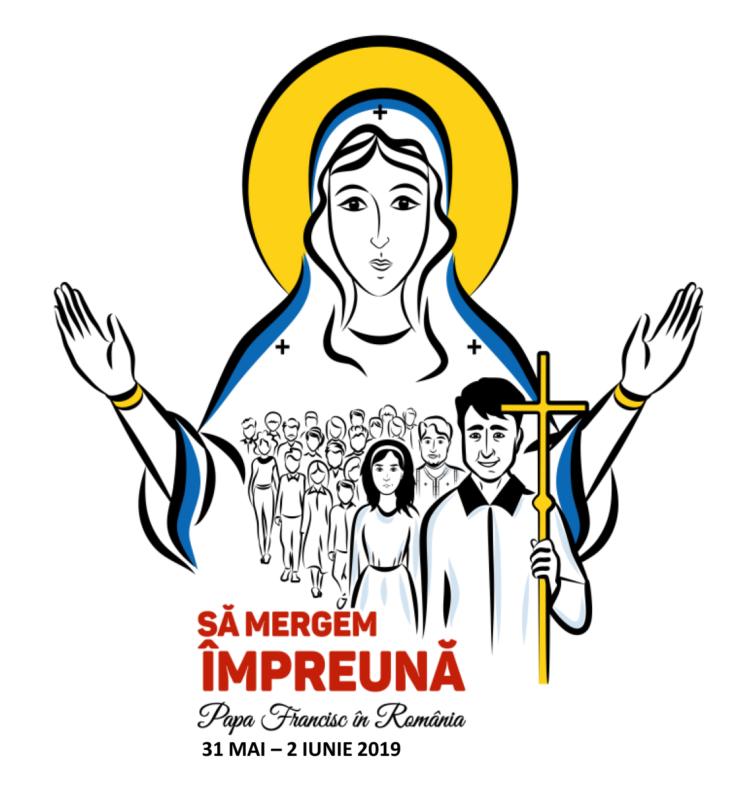
This is the logo for Pope Francis’ trip to Romania in late May to call for unity and a greater focus on the common good. The theme of the visit is “Let’s walk together” and shows Mary, the Mother of God, protecting the people of God in Romania – a country St. John Paul II visited in 1999. It will be Pope Francis’ fifth trip in the first six months of 2019. (CNS image/courtesy Holy See Press Office)
ROME (Crux) – When Pope Francis lands in Romania in late May, the local church hopes that he will be able to encourage a “spiritual wind” from the East into Europe and rebuild the chilled relations between the Catholic and Orthodox communities in the country.
“This side of Europe is a little bit more tied to spirituality, it’s not yet as predominantly attached to the material world as the West,” said Romanian Father Francisc Dobos, spokesman for the Catholic Archdiocese of Bucharest, in a March 18 interview with Crux.
“It can become a place to say: ‘Europe wake up! Take a breath from a spiritual point of view’,” he added.
The interview took place after a meeting with the press organized by Rome’s Opus Dei-run Santa Croce University, to discuss the May 31 to July 2 papal visit to the Eastern European country of Romania.
Over 80 percent of the Romanian population is Eastern Orthodox, with Catholic faithful representing a minority at only 4.7 percent, according to a 2011 census. While dialogue between the two denominations is “peaceful and open,” Father Dobos said during his presentation, it has become “more rigid” and “less fruitful than before.”
When Saint John Paul II visited Romania in 1999, he could rely on his strong personal relationship with the then head of the Romanian Orthodox church, Patriarch Teoctist. This bond was manifest in frequent ecumenical displays in the country, from praying together to attending each other’s Masses.
But according to local clergy the relationship between Catholics and Orthodox lost most of its enthusiasm once Patriarch Daniel took the helm of the Romanian Orthodox church in 2008.
The new Patriarch “has not encouraged the celebration of joint prayers, not with Catholics nor with any other religious denominations. There is not even anymore a joint prayer during the Week of Prayer for Christian Unity,” said Archbishop Ioan Robu of Bucharest, president of the Romanian bishops’ conference in an interview last year.
According to Father Dobos there are many examples of sincere friendship and dialogue with individual Orthodox priests, but some fringes of the majority religion struggle to consider Catholicism a “sister faith.”
“For the Orthodox church when we use the term ecumenism it’s like having an electric shock,” he said, adding in a positive spin that “if we don’t have ecumenism, well, then we have bridges, we knock down walls and we walk together.”
Relations are particularly strained between the Orthodox Church and Greek Catholic minority, which suffered some of the harshest oppression during the 1948-1998 Communist regime. The Greek Catholic faith was outlawed, and its properties handed over to the Orthodox church.
Since some of that property was never returned – including a much-disputed cathedral in Baia Mare – the tensions persist. As Robu described, “relations between Greek Catholics and Orthodox are living a sort of winter.”
Addressing the complex relations with the Orthodox majority will probably be on Pope Francis’s to-do list once he arrives in Romania on the 20thanniversary of John Paul II’s historic visit. The country’s widespread corruption and the diaspora of many of its citizens to other European countries are two other important issues that the local church hopes the pontiff will address, Dobos said.
In 2007, when Romania joined the European Union, up to 3.4 million Romanians left their country, according to a 2018 study by Immigrant Integration Research Centre at Move, an international conference discussing migration and the integration of migrants. In 2016 the number of young people aged 15-29 fell by 28 percent, according to Eurostat data.
These alarming numbers have impacted not only the country’s long-term future, but also the survival of its religious minorities that have witnessed their ranks substantially diminished.
Father Dobos hopes that Pope Francis’s papal visit may reinvigorate the local Catholic Church by encouraging it to reach out to believers not only with the Sacraments, but also with a “social engagement for the common good.”
The goal is “for Catholics to become a voice in the public realm,” he added. “To be brave and realize that we have a role, just like the Greek Catholics, in the creation of Romania.”
As Kei-Landa Rembert started to write a new song, she pulled inspiration from one of the toughest moments of her life.
Rembert, explained, “A month ago a fire happened in my home.”
On February 23rd, the apartment Kei-Landa shared with six other family members erupted in flames. The family and their three pets made it out safe and they were able to warn their neighbors about the fire, but their apartment was destroyed.
Rembert, said, “It was something unexpected. Something nobody could truly prepare for and it pushed my family and I out of our home and so right now we’re just displaced, trying to figure out what to do next.”
In addition to losing their home, they lost all of their possessions. God and music are helping the Rembert family through this trying time.
Kei-Landa Rembert explained, “We haven’t sunk to low because we know that God has a plan and we are trusting him with where he is going to lead us.”
Her mother, Vita Rembert, added, “God has truly had each and every one of us at peace. He’s in control so none of us are actually complaining, we’re just taking it one day at a time.”
The family is Christian and music has always been a part of Kei-Landa’s life. Back in 2017 she wrote and performed the popular song, “Put Him on Your List” for DeSales Media Group’s Christmas Campaign of the same name, which urged Catholics to go to church during Christmas time.
A month after the devastating fire, the Rembert family is now rebuilding. They are living in a hotel while they search for their next home, but still God gives them hope.
“It’s hard to realize what we have lost but we know that’s not where our story ends, we are going to keep moving forward and see what God does,” said Kei-Landa Rembert.
A GoFundMe has been set up to help the Rembert family on their new journey.
March Madness, college basketball’s national championship tournament season, gets underway today.
This year, Saint John’s, Iona and other Catholic schools across the country will be playing – and they usually play pretty well.
Writer for the website ‘Religion Unplugged,’ Clemente Lisi, joins Currents News to discuss how being mission oriented in their approach to education can lead Catholic universities to prime geographic locations for recruiting.
On the newscast: Cardinal Daniel DiNardo is resting comfortably after suffering a mild stroke. We’ll have important information on spotting warning signs in time; Two priests are on a mission, returning to the Queens school where their vocations took root; Bishop Nicholas DiMarzio on Fifth Avenue, reviewing the Saint Patrick’s Day Parade; The steps Christ climbed before his crucifixion are on public display after centuries.
Today’s top news from the Catholic perspective anchored by Liz Faublas. Currents News airs Monday through Friday at 7:00 p.m. ET on NET-TV (netny.tv)
Cardinal Daniel DiNardo is resting in a Texas hospital after suffering a mild stroke Friday, March 15th. He’s the president of the United States Conference of Catholic Bishops and also the archbishop of the Galveston-Houston archdiocese.
“We call it a ‘brain attack,’ said Doctor Margaret Eckert-Norton. She is the Assistant Director of Nursing at Brooklyn’s Saint Joseph’s College; “A stroke means your brain is not getting enough oxygen, and that could be very detrimental to your functioning.”
Eckert-Norton urged people to call 911 immediately if they have the following warning signs: numbness in your face, arms or legs; blurred vision; difficulty speaking; trouble with coordination or walking; and headache. One way to prevent a stroke is living an active lifestyle. “Sitting is the new smoking. We really want to make sure we have activity to make our blood vessels healthy,” said Eckert-Norton.
Church officials in Houston released a statement, reading, “It is expected that Cardinal DiNardo will remain hospitalized for a few more days of testing and observation, followed by a transfer to another facility for rehabilitation.”
The 69-year-old cardinal has been keeping a very full schedule. At last November’s general meeting of U.S. bishops, he talked about accountability. “We’ll work on finalizing the standards of accountability for bishops, finalizing the protocol for removed bishops, and studying national guidelines for the publication of lists of names of those clerics facing substantiated claims of abuse,” said Cardinal DiNardo.
While Cardinal DiNardo recovers from the stroke, Los Angeles Archbishop Jose Gomez, who’s the conference vice president, is taking over day-to-day responsibilities.
Brooklyn’s Bishop Nicholas DiMarzio reacted to the news, releasing a statement: “On behalf of the Diocese of Brooklyn, we send our prayers for Cardinal DiNardo’s complete recovery and a speedy return to his ministry.”
Cardinal DiNardo was elected USCCB president in November 2016. His three-year term expires this November.