Christians Celebrate Unity During Advent

By Emily Drooby

Kaitlyn Colgan is Catholic and Michael Rudzena is a non-denominational Christian.

Kaitlyn Colgan is Catholic and Michael Rudzena is a non-denominational Christian.  But on Dec. 5, they worshiped together at an Advent celebration. It was a night of prayer and unity among all Christians —  from Auxiliary Bishop James Massa of the Diocese of Brooklyn, to Pentecostal leader Joe Tosini.

“There is so much that we have in common and so much we can share with one another,” said Colgan.

“I’m encouraged. I’m encouraged in a moment that’s very polarized, I’m encouraged to see people moving towards each other. I’m encouraged to see people with an open and eager posture,” explained Rudzena.

The event, hosted by the John 17 Movement was started by Joe Tosini four years ago.

The name, “John 17,” refers to the chapter of the Gospel when Christ prays for his believers to unite.

“John 17 is an initiative where we are saying we just want to come to a table of friendship just like the last supper, we want to start at the feet, not at the head and we want to listen to each other,” said Tosini.

“Building relationships between pastors, between congregations and between believers in Christ to come together for prayer and fellowship and that’s what we are doing tonight,” said Bishop Massa.

The group supports an understanding and open communication between all Christians, an idea close to Pope Francis’s heart.

Just days prior to the event, the Holy Father even sent a letter in support of the movement, it was read aloud by Bishop Massa.

“With all of his many obligations, and his many responsibilities as the head of the church he takes time for this because he believes in it,” said Bishop Massa.

Together, Christians embraced their similarities and their differences with one goal in mind: unity.

Remembering Persecuted Christians this Holiday Season

By Emily Drooby

17,000 red lights and 2,500 red bows adorn the Diocese of Brooklyn’s 2019 Christmas tree as a nod to Christians who have been victimized for their beliefs.

“When you go to Mass in Pakistan on Sunday, you don’t know if you’re going to come back,” explained Crux’s Rome Bureau Chief, Inés San Martín as she spoke about the issue of Christian persecution plaguing the globe.

Christians are facing violence in countries like Pakistan, Syria and Sri Lanka.

“There are 300 million people who live in places where saying that word —  ‘Christmas’ or ‘Christ’ — could be potentially dangerous,” said Ed Clancy, the Director of Outreach and Evangelization for Aid to the Church in Need, one of the biggest organizations assisting persecuted Christians.

The world-wide issue has been growing. In 2014, it affected 108 countries. By 2017, it had spread to 143 countries.

“This is all over the world…It’s not exclusive to the areas of the hot spot-talk about in the Middle East, South America, or in Asia, it’s happening in a lot of places,” explained Clancy.

It’s not just from Islamic Extremists: Christians around the world are facing all different types of persecution.

Persecution happens in China, where the government closely monitors religion.

Persecution also happens in Mexico and South America, where religious leaders tend to clash with criminals.

“Priests tend to be the only thing between drug dealers and the youth, so priests are killed but most of them are constantly threatened, have their parishes attacked,” explained San Martín.

“They are heroes, they are martyrs, they are people of faith that we should revere and really constantly keep in our prayer, their sacrifices,” said Mario Paredes, a longtime leader in the Hispanic-American community.

This year, Aid to the Church in Need is asking everyone to place a red ribbon on their Christmas tree as a reminder of those who face persecution for their faith.

Currents News for Thursday, December 5, 2019

On the newscast: House Speaker Nancy Pelosi announces the impeachment is going forward – then hits back hard when a reporter asks if she hates President Trump; New details about why the beatification of Archbishop Fulton Sheen has been put on hold; An urgent warning about new online scams targeting holiday shoppers; And the Vatican unveils the Nativity and lights the Christmas tree in Saint Peter’s Square.

Watch weeknights at 7:00 pm EST on NET-TV in the New York City area on Spectrum, Optimum, and Fios. Subscribe to our YouTube channel to receive notifications about new content.

Bishop Malone Resigns: Former Executive Assistant Warns Future Bishop

By Tim Harfmann

For over a year, many people publicly demanded that Buffalo’s Bishop Richard Malone resign.

One day after doing so, a protest leader is putting his eventual replacement on notice. 

“Any bishop who comes in here should be on his guard,” said Siobhan O’Connor, who used to work for Bishop Malone as his executive assistant. She leaked documents to the press accusing him of mishandling abuse cases — a move that sparked the crisis in Buffalo. 

In the wake of Bishop Malone’s resignation, she said Catholics in Buffalo will be watching the next bishop closely.

“He should be perhaps a little trepidatious to come here, because he knows that we are laity that’s informed. We stand with survivors, and I would hope that whoever is assigned here will know that he has to be at his best and certainly not following Malone’s playbook,” O’Conner added.

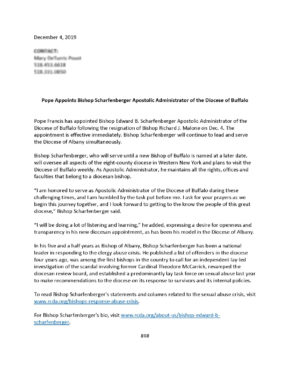
The Vatican has appointed Bishop Edward Scharfenberger of the Diocese of Albany as the apostolic administrator of Buffalo until a permanent replacement is named.

He’s said he’s planning on making weekly visits to Buffalo.

“I would like every parish to be an oasis of security where people can come home and nobody feels left out,” Bishop Scharfenberger said. 

The Brooklyn-born bishop was appointed by the Holy Father to lead the Diocese of Albany five-and-a-half years ago, and has become a national leader in responding to clergy abuse in Albany.

He established a confidential reporting line, created a victim assistance coordinator and setup a predominately lay task force on sexual abuse, among many other initiatives.

Bishop Scharfenberger is promising similar action in Buffalo.

“If it means clarifying our lists, you know, putting names up, putting up more information, whatever can be done in a way that is transparent and responsible – absolutely,” he said. 

O’Connor says she’s happy with the departure of Bishop Malone, but is also reportedly disappointed that the Holy See didn’t release the report prepared by Brooklyn’s Bishop Nicholas DiMarzio of his Vatican appointed visitation to Buffalo.

Catholic Student Wins Language Competition in China

By Tim Harfmann

Singing in the Chinese language of Mandarin is second nature for Lee Berat. For Lee, her knowledge goes beyond just singing: she’s an all-around winner when it comes to speaking Mandarin.

Her family is of Albanian and Italian descent, but she’s been learning to speak the language since the age of four.

“We used to have a Chinese nanny and she only spoke Chinese, so that’s how we communicated with her,” Lee explained.

Now she’s communicating in Chinese on a global scale.

Lee recently traveled to the Asian country for an international competition, and beat nearly 200 Mandarin-speaking students worldwide.

“You see that all other people from other different places, they also speak Chinese. And you can kind of relate to them in a way,” she said.

The junior at Xaverian High School in Bay Ridge, Brooklyn wants to relate to others by becoming a doctor.

As part of the competition, she recited a speech in Mandarin about her future.

“I would like to use Chinese in my profession, so I can help out people in China that don’t know how to speak English and aren’t able to have this, sort of, care from doctors,” Lee said.

Lee is one of nine sisters, and they’re all fluent in the language.

“I’m really happy for my sister, in that we get to share this special bond and learn Chinese together,” said Langley, Lee’s younger sister.

Xaverian’s principal, Deacon Kevin McCormack, says although the Brooklyn school is full of diversity, Lee is unique.

“No one’s surprised to hear that someone can speak French, or Italian, or Spanish or Greek in Xaverian. But Mandarin? A little different,” he explained.

It’s all to learn and respect another language.

Currents News for Wednesday, December 4, 2019

On the newscast: We have reaction to the resignation of Bishop Richard Malone – after allegations of mishandling clergy sexual abuse cases; We hear from Brooklyn-born Bishop Edward Scharfenberger, who will lead the Buffalo Diocese until Pope Francis appoints a permanent successor; During his weekly audience in St. Peter’s Square, the Holy Father warns about the dangers of magic; And a winning college athlete gives the gift of life – we’ll have her charitable story.

Watch weeknights at 7:00 pm EST on NET-TV in the New York City area on Spectrum, Optimum, and Fios. Subscribe to our YouTube channel to receive notifications about new content.

Buffalo’s New Apostolic Administrator Has History of Combating Abuse

By Tim Harfmann

Albany’s Bishop Edward Scharfenberger promised to bring his powerful history of protecting young and vulnerable people from abuse to his new assignment in Buffalo.

His assured Catholics on Dec. 4 that he understands their need for healing.

“This family has been suffering quite a bit in recent months and years, and my heart just goes out to you. And what I see is a need for a tremendous amount of healing,” said Bishop Scharfenberger.

He outlined what his first step would be to help the diocese overcome the past.

“My first priorities will primarily be to listen. I want to hear what’s in your hearts and what your concerns are, where you think we should go,” he said.

Bishop Scharfenberger is taking on the Buffalo mission while he continues as leader of the Diocese of Albany.

The practices he put in place there will accompany him in his new assignment.

“I want everyone to know that they will be treated with respect. I continue, as I do in the Diocese of Albany, to say, ‘if you see something, say something,” he said.

The Brooklyn-born bishop was appointed by Pope Francis to lead the Diocese of Albany five-and-a-half years ago.

Building on his experience in the Diocese of Brooklyn, he’s become a national leader in responding to clergy abuse in Albany.

The bishop established a confidential reporting line, created a Victims Assistance Coordinator to work with survivors, and setup a predominately lay task force on sexual abuse, among many other initiatives.

He promised action in Buffalo.

“If it means clarifying our lists, you know, putting names up, putting up more information. Whatever can be done in a way that is transparent and responsible — absolutely,” he said.

As a Brooklyn priest, Scharfenberger was a member of the diocesan review board for sexual abuse of minors.

He believes his service in the diocese has better prepared him for his new appointment.

“It was an emotionally, spirituality, humanly, and very enriching experience for me in my life. And, I have to say, has great deal to do with my life right now.”

Bishop Scharfenberger said he doesn’t know how long he’ll be in Buffalo, but he’s vowing to do everything possible to protect people from abuse.


Click here to read a statement from the Diocese of Albany regarding Bishop Malone’s resignation:


Pope Francis Accepts Bishop Malone’s Resignation

By Emily Drooby

Pope Francis accepted the immediate resignation of Bishop Richard Malone of Buffalo, N.Y. on Wednesday morning.

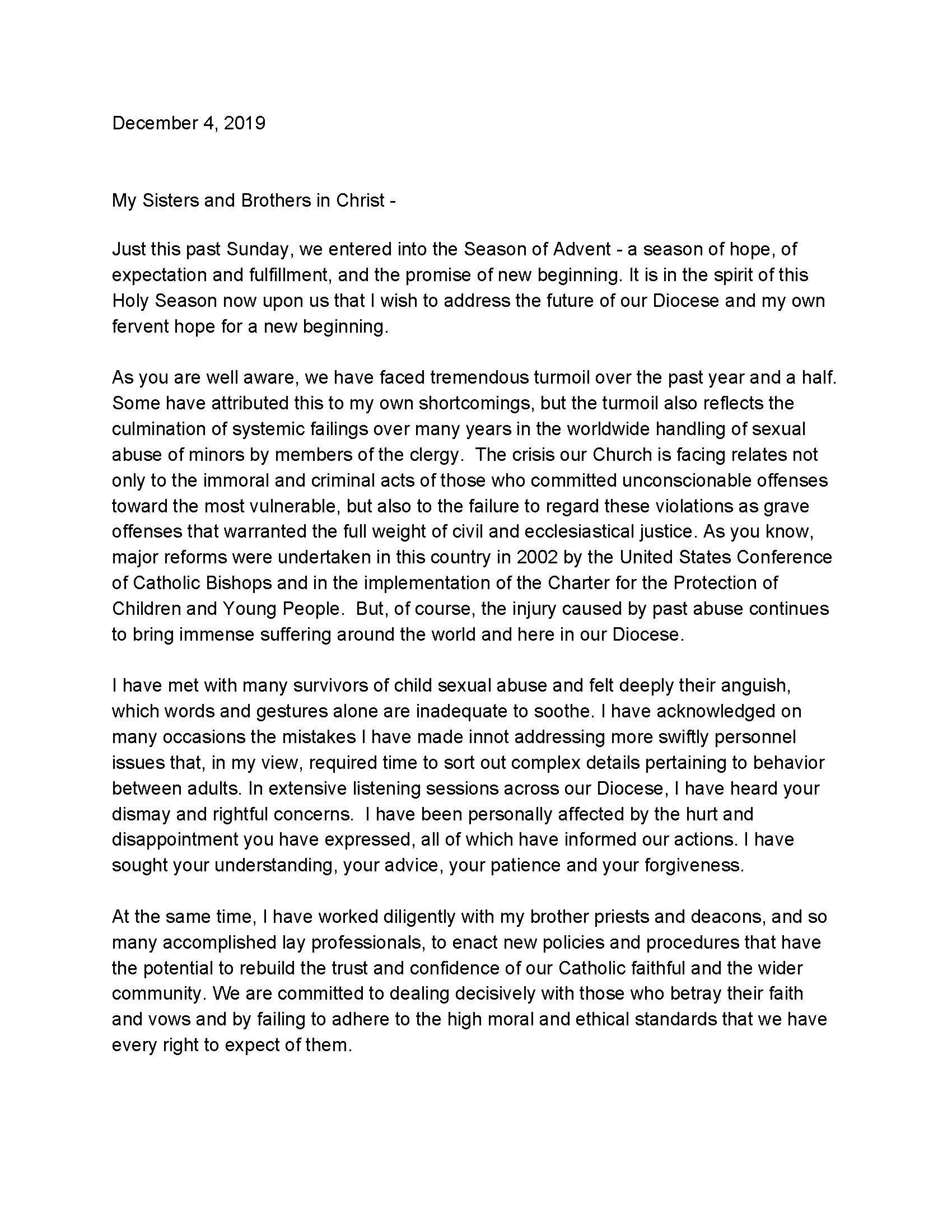
In a letter to the faithful after the announcement of his resignation, Bishop Malone said: “I have concluded after much prayer and discernment that the spiritual welfare of the people of the Diocese of Buffalo will be better served by a new bishop who perhaps is better able to bring about the reconciliation, healing and renewal that is so needed.”

The resignation comes just weeks after Bishop Nicholas DiMarzio concluded his Vatican appointed visitation to Buffalo to examine mounting allegations of clergy sex abuse and a possible cover-up.

However, in Bishop Malone’s letter he said the fact-finding mission had little to do with his decision to resign.

“Inevitably, some will surmise that my decision is the result of the recently-completed Apostolic Visitation, carried out by Bishop Nicholas DiMarzio at the behest of the Holy See. While I was made aware of the general conclusions of the report, which were a factor in my discernment, my decision to retire early was made freely and voluntarily,” wrote Bishop Malone.

Also, on Wednesday morning Bishop DiMarzio released a statement in part saying:

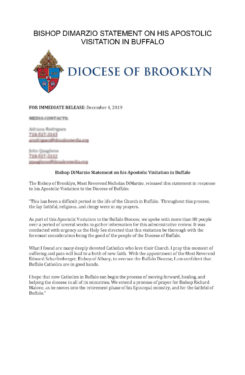
“This has been a difficult period in the life of the Church in Buffalo…As part of this Apostolic Visitation… we spoke with more than 80 people over a period of several weeks to gather information for this administrative review. It was conducted with urgency as the Holy See directed that this visitation be thorough with the foremost consideration being the good of the people of the Diocese of Buffalo.”

The Vatican also announced that Albany, N.Y. Bishop Edward Scharfenberger, has been named apostolic administrator of the Diocese of Buffalo until a permanent successor is named.

During a news conference on Wednesday, Bishop Scharfenberger said he has known he was being considered for the role since the beginning of November.

“I received a call from the apostolic nuncio, Archbishop Pierre, that I was being considered as a possible appointee as apostolic administrator, and that he would take that to the Holy Father,” said Bishop Scharfenberger.

A native of Brooklyn who grew up in Queens, Bishop Scharfenberger was ordained a priest of the Diocese of Brooklyn in the 1970s. The new apostolic administrator promised transparency and to do a lot of “listening and learning.”

People in Buffalo have called for this resignation ever since details emerged about a hidden list of accused priests, and secret phone recordings.

The crisis escalated when his executive assistant, Siobhan O’Connor, leaked hundreds of pages of diocesan records.

“I hope we are not going to have to do a lot more protesting. I mean we really don’t want to I know people seem to think we really enjoy this but we don’t,” explained O’Connor, speaking during a protest against Bishop Malone back in November.

Bishop Malone, who had led Buffalo since 2012, had resisted numerous calls from clergy, seminarians and lay leaders in the diocese to step down.

Bishop Scharfenberger said he hopes this marks a new beginning for the Diocese of Buffalo.


Click here to read Bishop Malone’s Letter to Catholic Faithful:


Click here to read Bishop DiMarzio’s statement on his Apostolic Visitation in Buffalo:


Click here to read a statement from the Diocese of Albany regarding Bishop Malone’s resignation:


Vatican Welcomes Refugees, Offering a Chance to ‘Restart Life’

By Melissa Butz

On the morning of Dec. 4, at the request of Pope Francis, 33 asylum seekers flew into Rome from the Greek island of Lesbos, alongside Holy See representatives and those from the SantEgidio lay community.

The refugees from Moria camp were warmly welcomed to Italy by members of the Vatican’s Office of Papal Charities at Rome’s Fiumicino airport.

Later this month, another 10 asylum seekers will join them. They will be hosted by the Holy See as part of the Humanitarian Corridors project by SantEgidio.

“Finally, after a complicated process, we are happy to welcome you to Italy,” Andrea Riccardi, founder of Sant’Egidio, told them.

“This sign is calling us to finally wake up. There are 15,000 people who live in disastrous conditions and we are fine. Almoner means sharing myself with others – my favorite things and my personal space,” said Cardinal Konrad Krajewski, almoner of the Office of Papal Charities. 

The initiative originally began with Pope Francis in April 2016, soon after he was elected pope. He traveled to the Moria camp in Lesbos and brought three Syrian families back on his plane with him. Soon after, nine more people followed.

As a continuation, in May 2019, the papal almoner and founder of Sant’Egidio traveled to Lesbos to visit the migrant reception facilities, at the request of the Holy Father.

“The pope holds Lesbos in his heart because he was there,”explained Andrea. “I went to talk to him after I visited Lesbos and he asked me, ‘Years after my visit, what happened?’ I told him the situation and he said, ‘Let’s give them at least one small sign of peace. Let them come here.’”

Cardinal Krajewski and Andrea went back this week to bring these 33 back to Italy.

There are Afghan families, a lady from Cameroon and one from Togo. All have lived in the camp for at least one or two years.

Now, drawing from the frontline of the migrant crisis, the Vatican and Sant’Egidio are giving them the opportunity to “restart life.”

Bishop Malone Resigns Following Bishop DiMarzio’s Fact-Finding Mission

By Christopher White, National Correspondent

NEW YORK — Pope Francis has accepted the immediate resignation of Bishop Richard Malone of Buffalo, N.Y. on Wednesday morning. The announcement comes two months after the Vatican asked Bishop Nicholas DiMarzio to conduct a fact-finding mission into the Diocese of Buffalo, which has been roiled with claims that Bishop Malone has mishandled numerous abuse cases. The resignation was announced in Washington, D.C., by Archbishop Christophe Pierre, apostolic nuncio to the United States.

Archbishop Pierre also announced that Albany, N.Y, Bishop Edward Scharfenberger, a native of Brooklyn who grew up in Queens, has been named apostolic administrator of the Diocese of Buffalo until a permanent successor is named.

In a letter to the faithful after the announcement of his resignation, Bishop Malone said:

“Inevitably, some will surmise that my decision is the result of the recently-completed apostolic visitation, carried out by Bishop Nicholas DiMarzio at the behest of the Holy See. While I was made aware of the general conclusions of the report, which were a factor in my discernment, my decision to retire early was made freely and voluntarily. I have come to this decision with honest reflection and a deep and abiding commitment to doing what I believe is in the best interests of the Church throughout Western New York.”

Bishop DiMarzio made three trips to Buffalo in October for his visitation and interviewed more than 80 diocesan officials, clergy and laypeople in the diocese. He submitted a report to the Vatican at the beginning of November.

“It was conducted with urgency as the Holy See directed that this visitation be thorough with the foremost consideration being the good of the people of the Diocese of Buffalo,” Bishop DiMarzio said in a statement Wednesday morning.

“What I found are many deeply devoted Catholics who love their church…I pray this moment of suffering and pain will lead to a birth of new faith. With the appointment of the Most Reverend Edward Scharfenberger, bishop of Albany, to oversee the Buffalo Diocese, I am confident that Buffalo Catholics are in good hands.”

In a news conference on Wednesday, Bishop Scharfenberger said that he has known since the beginning of November that he was being considered for the role. “I received a call from the apostolic nuncio, Archbishop Pierre, that I was being considered as a possible appointee as apostolic administrator, and that he would take that to the Holy Father,” said Bishop Scharfenberger.

Bishop Scharfenberger, who was ordained as a priest of the Diocese of Brooklyn in 1973, said, “I am honored to serve as apostolic administrator of the Diocese of Buffalo during these challenging times, and I am humbled by the task put before me. I ask for your prayers as we begin this journey together, and I look forward to getting to know the people of this great diocese.”

press release from the Diocese of Albany highlighted that “In his five and a half years as Bishop of Albany, Bishop Scharfenberger has been a national leader in responding to the clergy abuse crisis. He published a list of offenders in the diocese four years ago, was among the first bishops in the country to call for an independent lay-led investigation of the scandal involving former Cardinal Theodore McCarrick, revamped the diocesan review board, and established a predominantly lay task force on sexual abuse last year to make recommendations to the diocese on its response to survivors and its internal policies.”

In a video message published on the Diocese of Albany Facebook page, the Bishop Scharfenberger announced that his “family just got a little bit bigger,” and that he plans to visit the Diocese of Buffalo, which covers eight counties in western New York state, weekly. “I will be doing a lot of listening and learning,” he said.

Bishop Scharfenberger has led the Diocese of Albany since 2014. Before that, he was the pastor of St. Matthias Church in Ridgewood, Queens, for 11 years. He also served as judicial vicar for the Roman Catholic Diocese of Brooklyn from 1993 to 2002. Bishop Scharfenberger has a degree in Canon Law from the Catholic University of America, and a law degree from Fordham University. He was admitted to the New York State Bar in 1991.

Bishop Malone faced accusations that he knowingly covered up for priests credibly accused of abuse. One of those priests, retired Father Norbert F. Orsolits acknowledged in 2018 that he had molested “probably dozens” of teenage boys in the 1970s and 1980s. Those revelations sparked scrutiny of Bishop Malone. He resisted numerous calls from clergy, seminarians and lay leaders in the diocese to step down.

Last month, Bishop Malone was in Rome with fellow prelates from New York state for their regularly scheduled “ad limina” meetings with Pope Francis and the Roman curia. While he was in Rome, Bishop Malone was the principal celebrant of a Mass at the Basilica of Saint Paul’s Outside the Walls, where he quoted from Pope Francis’ catechesis on Christian hope, saying, “In these times that appear dark, in which we sometimes feel disoriented by the evil and violence that surround us, by the distress of so many of our brothers and sisters, we need hope.”

Following his return from Rome, Bishop Malone issued a statement, saying that Pope Francis is aware of the difficult situation that he and the diocese are facing.

“He was very understanding and kind,” Bishop Malone wrote, referring to a private conversation he had with the pope.

Last year, the Diocese of Buffalo attracted national attention when Bishop Malone’s former executive assistant, Siobhan O’Connor, leaked hundreds of pages of diocesan records allegedly showing that Bishop Malone had allowed accused priests to continue to minister and that he has actively engaged in a cover-up.

In September, Father Ryszard Biernat, Bishop Malone’s priest secretary, leaked secret recordings in which the bishop voiced concerns that one of those scandals could force him to resign.

Father Biernat himself faces allegations that he engaged in a longtime relationship with Matthew Bojanowski, a former diocesan seminarian. Despite the publication of correspondence between Father Biernat and Bojanowski that appears to be romantic in nature, Bishop Malone has said he has no reason to believe the relationship wasn’t platonic.

In an interview with a local Buffalo station earlier this year, Bishop Malone said the diocese is facing 138 abuse lawsuits since a “look back” window in New York state took effect in August that lifts the statute of limitations on abuse cases against a public institution for one year. He said his advisers estimate that 250 to 275 lawsuits will be filed and that the diocese is in “very serious discernment” over whether to file for bankruptcy.

Bishop Malone is now the third U.S. bishop to step down during the last year after abuse-related allegations were made. In the first two cases, the pope accepted their ordinary resignation, which they had previously submitted when they turned 75 years old. The first was Bishop Michael Bransfield of West Virginia, who is accused of both financial and sexual misconduct, and the second was Cardinal Donald Wuerl of Washington, who resigned after scrutiny of his handling of abuse cases while he was bishop of Pittsburgh in the 1980s. Bishop Malone is 73 and was not required to present his resignation until 2021.

Bishop Malone served as an auxiliary bishop in Boston under Cardinal Bernard Law from 2001 to 2004 and was then named bishop of Portland, Maine, a post he held until his appointment to Buffalo in 2012.


Click here to read Bishop Malone’s Letter to Catholic Faithful:


Click here to read Bishop DiMarzio’s statement on his Apostolic Visitation in Buffalo:


Click here to read a statement from the Diocese of Albany regarding Bishop Malone’s resignation: