NYPD Memorial Mass Remembered Officers Lost to COVID

Currents News Staff

New York’s finest are praying for their fellow officers who were lost due to the COVID-19 pandemic.

The Memorial Mass at St. Patrick’s Cathedral in Manhattan remembered and honored 46 brave men and women who returned to the Lord. The service had limited seating due to the pandemic and social distancing restrictions.

In attendance was Mayor Bill de Blasio and NYPD Commissioner Dermot Shea.

New York Cardinal Timothy Dolan and Brooklyn Bishop Nicholas DiMarzio talk about how the force has stuck together through these tough times.

“They often say the NYPD is a family,” says Cardinal Dolan, “and sometimes that seems like a cliche, but when you see something like this, you know that it’s not, they are a family.” 

Bishop DiMarzio says the families were given comfort and consolation.

“That’s what our remembrance is about,” says Bishop DiMarzio, “We don’t forget. We don’t forget our loved ones. We don’t forget those who served the city. We want to honor them and we have done that today.”

Cardinal Dolan and Bishop DiMarzio also blessed the medallions that were handed out to those families.

Analysis: Like a Century Ago, a Papal Encyclical Tries to Shed Light on a Dark Time

By Currents News Staff and John L. Allen Jr.

ASSISI, Italy (Crux) – A great global crisis has rocked the world, leaving millions afflicted and sowing fear everywhere. The shock polarizes societies, radicalizes opinion, and reinforces trends to a new kind of politics – loud, angry, premised on demonizing others and promising to restore lost national glory.

Unless something dramatic changes, the stage seems set for a long, bloody conflict. In that context, a pope writes an encyclical letter attempting to offer an alternative before it’s too late.

That could easily be a description of Pope Francis and “Fratelli Tutti,” the new encyclical he signed Oct.3 in Assisi and which was released today by the Vatican. In fact, however, it’s the background to “Quadragesimo anno,” the social encyclical published by Pope Pius XI in 1931, now almost a century ago. It was written as the Great Depression was raging, Benito Mussolini was firmly in control in Italy, and Adolph Hitler was moving inexorably towards power in Germany.

In the encyclical, Pope Pius XI laid out the insufficiencies of both free-market capitalism and socialist communism and tried to sketch a third way, rooted in traditional Catholic social teaching but sensitive to the realities of the time.

In a sense, “Quadragesimo anno” was Pope Pius XI’s attempt to defuse the bomb before it went off. (It would become ever more explicit six years later in “Mit Brennender Sorge,” Pope Pius XI’s encyclical denouncing National Socialism.) Those efforts failed, and the explosion Pope Pius saw coming turned out to be worse than even he could have imagined.

Time will tell what impact “Fratelli Tutti” may have, but the parallels are striking.

This is Pope Francis’ third encyclical letter, after “Lumen Fidei” in 2013 (a text largely prepared under Pope Emeritus Benedict XVI) and “Laudato Si’” in 2015, and by far his most comprehensive. One has the sense it’s almost this pope’s social and political testament, an encapsulation of his entire papacy in a little over 40,000 words.

“Fratelli Tutti” contains myriad points, and no doubt will be subject to a thousand different spin cycles. Some may choose to link certain passages to current events – it’s going to be awfully tempting for many Americans, for instance, to flash on the recent Trump/Biden fracas in pondering paragraph 15: “In this craven exchange of charges and counter-charges, debate degenerates into a permanent state of disagreement and confrontation.”

For the record, Pope Francis penned ”Fratelli Tutti” well before the American contenders squared off, and clearly his horizons are much larger than the United States. For that matter, he tells us in paragraph 7 that he began the letter even before the current COVID-19 crisis erupted.

Perhaps the best overall way to frame the encyclical is as an extended meditation on political and economic life in the early 21st century, including the impact of the coronavirus crisis. Pope Francis sees a contest between two flawed alternatives: Neo-liberal individualism, and nationalist populism. His “third way” is a social ethic of human fraternity, rooted for Christians in the Gospel parable of the Good Samaritan.

The Holy Father’s diagnosis of the internal contradictions of neo-liberalism is especially acute in paragraph 168.

“The marketplace, by itself, cannot resolve every problem, however much we are asked to believe this dogma of neoliberal faith,” the pontiff writes. “The fragility of world systems in the face of the pandemic has demonstrated that not everything can be resolved by market freedom.”

It’s important to stress that Pope Francis’ critique of hyper-individualism isn’t just a matter of economics but culture, and it’s not really left v. right. The secular progressive insisting on abortion rights is every bit as much a “neoliberal,” as Pope Francis would see it, as the country club Republican complaining about government intervention. Both reflect what Pope Francis calls a “cool, comfortable and globalized indifference” to others.

As an antidote to neoliberalism, Pope Pope Francis presents the traditional Catholic notion of the universal destination of goods, which means the right to private property always carries a “social mortgage.” That’s consistent with popes since Leo XIII in the late 19th century, though Pope Francis offers a novel twist by linking it to questions of national sovereignty raised by today’s immigration debates.

“Seen from the standpoint not only of the legitimacy of private property and the rights of its citizens, but also of the first principle of the common destination of goods, we can then say that each country also belongs to the foreigner, inasmuch as a territory’s goods must not be denied to a needy person coming from elsewhere,” he says in paragraph 124.

As for today’s brand of populism, the critical assessments offered in ”Fratelli Tutti” are too numerous to mention. Suffice it to quote paragraph 11’s denunciation of “myopic, extremist, resentful and aggressive nationalism,” which sets the tone for much that follows.

Anyone who follows political discussion these days, anyone who watches the news or who has a twitter account, certainly can confirm the pontiff’s diagnosis that such exchanges are increasingly nasty, exhibiting a kind of open rage that tells us something is seriously amiss.

“Things that until a few years ago could not be said by anyone without risking the loss of universal respect can now be said with impunity, and in the crudest of terms, even by some political figures,” Pope Francis writes in paragraph 45.

Pope Francis’ proposed remedy, human fraternity, may seem a bit fuzzy, and Pope Francis does not offer a detailed blueprint. However, he does give hints of planks for a platform along the way: Care for the elderly, combatting racism and sexism, compassion for immigrants, debt forgiveness for impoverished nations, a strong role for the U.N. and for regional alliances, and abolitionist positions on both war and capital punishment.

More than anything else, the specific issues treated in ”Fratelli Tutti” appear to be in service to illustrating an ethic of fraternity, one which begins with rejecting aggression as a means of relating to others – and the tendency to aggression, he believes, has been made significantly worse by the coronavirus and the shift to increasingly “virtual” relationships.

He’s equally clear that blood in the streets, in the name of whatever cause, isn’t the answer: “Violent public demonstrations, on one side or the other, do not help in finding solutions,” he writes in paragraph 232.

Make no mistake, Pope Francis isn’t terribly optimistic about where things are trending. He praises various points of light, including the emergence of popular social movements that he lyrically refers to as “social poets.” Nevertheless, it’s telling that even the sections of ”Fratelli Tutti” ostensibly devoted to hope quickly digress into various laments.

In a nutshell, Pope Francis sees these two great social “pandemics” – privileged individualist indifference and blind populist rage, apparently mutated into even stronger forms by the literal pandemic of the coronavirus – setting the stage for calamity unless some new force arises to counteract them.

In the short run, papal biographer Austen Ivereigh isn’t sanguine about the likely result.

“Just like the popes of the 1920s-30s, Pope Francis sees a dark road ahead, and he’s creating a space for Christians and others of goodwill to occupy in the coming conflict,” Ivereigh told me via email. “Like those earlier popes, he may not be listened to until we’re much further down that dark road.”

On the other hand, Duke historian James Chappel, author of the 2018 book, “Catholic Modern: The Challenge of Totalitarianism and the Remaking of the Church,” argues persuasively that those same 1920s and 30s-era popes saved the Church by shifting from condemning modernity from the outside to attempting to leaven it from within.

“The struggle against totalitarianism has concluded, Catholics won, and the contemporary Church was shaped to the core by that battle,” Chappel wrote.

Has Pope Pope Francis provided the Church with the resources to navigate another such great global struggle and come out the other side, alive and kicking? Only time will tell, but when that assessment eventually is drawn up, the conversation almost certainly will begin with ”Fratelli Tutti”.
Currents News full broadcast for Mon, 10/5/20

Currents News reports secular and religious news from the Catholic perspective.

Some of the top stories on this newscast:

In addition to closing all schools – including Catholic academies in the hot spot neighborhoods – the Governor has a warning about religious worship.

 The latest on President Trump’s condition as he’s treated for coronavirus.

 Paying tribute to the men and women of the NYPD who we’ve lost to coronavirus.

The Holy Father sharing his ideas on how we should face the world after the pandemic.

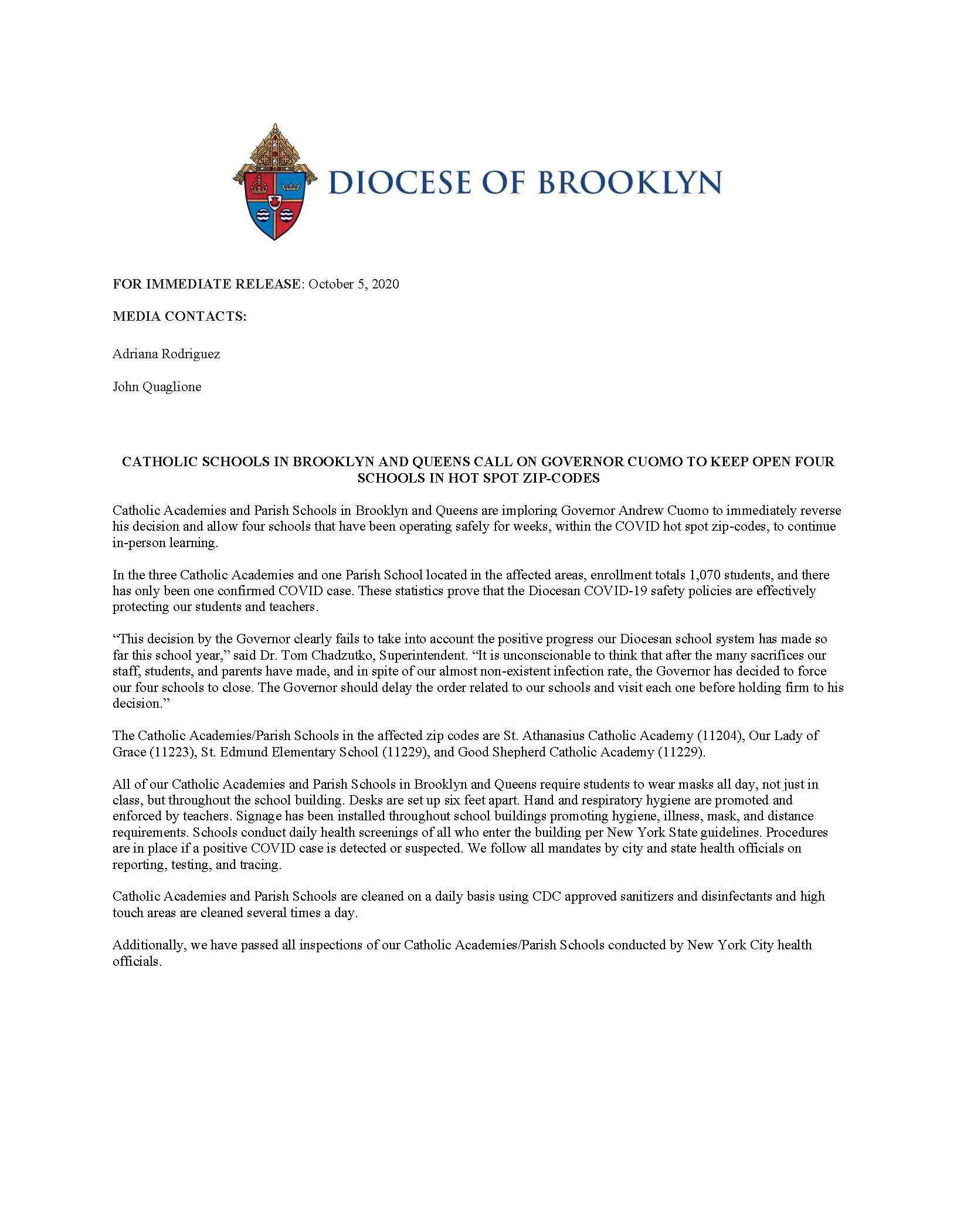
Brooklyn Diocese Asks Cuomo to Keep Catholic Schools Open Safely – Not Online – in COVID Hot Spots

By Emily Drooby and Erin DeGregorio

WINDSOR TERRACE — Parents from Good Shepherd Catholic Academy (Marine Park) will be meeting on the block of their school at noon on Oct. 6. In a socially distant manner, they will be expressing their frustration over Governor Andrew Cuomo’s announcement that certain Catholic academies and schools are included in temporary school closures in nine hotspot ZIP codes.

On Oct. 5, Gov. Cuomo announced all New York City schools within nine hotspot ZIP codes will physically close and pivot to remote learning on Oct. 6. This comes after New York Mayor Bill de Blasio announced a proposal on Oct. 4 to shut down schools and non-essential businesses within the areas with high positivity rates.

The neighborhoods/ZIP codes that have had above 3 percent coronavirus positivity rates for at least seven consecutive days include Edgemere/Far Rockaway (11691), Borough Park (11219), Gravesend/Homecrest (11223), Midwood (11230), Bensonhurst/Mapleton (11204), Flatlands/Midwood (11210), Gerritsen Beach/Homecrest/Sheepshead Bay (11229), Kew Gardens (11415), and Kew Gardens Hills/Pomonok (11367).

Five parish schools, Catholic academies, and high schools in the affected ZIP codes are Good Shepherd Catholic Academy (11229), Our Lady of Grace Catholic Academy (11223), St. Athanasius Catholic Academy (11204), St. Edmund School (11229), and St. Edmund Preparatory High School (11229).

During the Mayor’s press conference on Oct. 5 — a few hours after Gov. Cuomo’s press conference — Mayor de Blasio said the physical closures of schools could last two weeks minimum (with positivity rates under three percent for seven consecutive days) or as many as four weeks (whereby the last day of the four weeks positivity rates are under three percent).

Reaction from the Diocese of Brooklyn

Catholic academies and parish schools in Brooklyn and Queens are asking Gov. Cuomo to immediately reverse his decision and allow four schools that have been operating safely for weeks, within the COVID-19 ‘hotspots’ ZIP codes, to continue in-person learning.

In the three Catholic academies and one parish school located in the affected areas (St. Athanasius Catholic Academy, Our Lady of Grace Catholic Academy, St. Edmund Elementary School, and Good Shepherd Catholic Academy), enrollment totals 1,070 students, and there has only been one confirmed COVID case. “These statistics prove that the Diocesan COVID-19 safety policies are effectively protecting our students and teachers,” read a statement from the Diocese of Brooklyn.

“This decision by the Governor clearly fails to take into account the positive progress our Diocesan school system has made so far this school year,” said Brooklyn Diocese Superintendent of Schools Dr. Thomas Chadzutko.

“It is unconscionable to think that after the many sacrifices our staff, students, and parents have made, and in spite of our almost non-existent infection rate, the Governor has decided to force our four schools to close,” Chadzutko added. “The Governor should delay the order related to our schools and visit each one before holding firm to his decision.”

Click here to read the statement from the Diocese of Brooklyn

Other Areas to Watch

Mayor de Blasio has also said high-risk activities in 12 other ZIP codes — which have had climbing positivity rates for seven consecutive days — are being closely monitored. The areas could see closures of indoor dining, gyms, and indoor and outdoor pools beginning Oct. 7.

These 12 neighborhoods/ZIP codes include Bedford-Stuyvesant (West)/Clinton Hill/Fort Greene (11205), East Williamsburg/Williamsburg (11211 and 11249), Brighton Beach/Manhattan Beach/Sheepshead Bay (11235), Bergen Beach/Flatlands/Marine Park/Mill Basin (11234), Crown Heights (East) (11213), Kensington/Windsor Terrace (11218), Rego Park (11374), Fresh Meadows/Hillcrest (11366), Hillcrest/Jamaica Estates/Jamaica Hills (11432), Auburndale/Fresh Meadows/Pomonok/Utopia (11365), and Forest Hills (11375).

Trump Tweets That He Is Leaving Hospital, ‘Feeling Really Good!’

By Currents News Staff and Bill Miller

WINDSOR TERRACE — President Donald Trump departed the hospital shortly after 6:45 p.m. Monday, Oct. 5, wearing a mask and giving a thumbs up, following a weekend of medical treatments for COVID-19 virus.

Trump’s departure aboard a Marine One helicopter was shown in live streaming on numerous media outlets broadcasting from outside Walter Reed National Military Medical Center in Bethesda, MD.

Trump had tweeted earlier Monday that he’d be leaving the hospital at 6:30 p.m. He emerged at 6:39 pm., wearing a blue suit and blue-striped tie.

Camera shutters clicked away as a few reporters shouted questions. The president only said, “Thank you,” before stopping briefly alongside a Secret Service vehicle to give another thumbs up to the media.

The helicopter lifted off at 6:46 p.m. for the flight back to the White House.

Trump spent the weekend at the medical  center after testing positive for the COVID-19 virus.

“I will be leaving the great Walter Reed Medical Center today at 6:30 p.m.,” Trump wrote on Twitter at 2:37 PM on Monday, Oct. 5. “Feeling really good! Don’t be afraid of COVID. Don’t let it dominate your life. We have developed, under the Trump Administration, some really great drugs & knowledge. I feel better than I did 20 years ago!”

The Associated Press, meanwhile, reported that Trump’s physician, Dr. Sean Conley, said the president “may not entirely be out of the woods yet.”

Conley added, however, that members of the president’s medical team “agree that all our evaluations and, most importantly, his clinical status support the president’s safe return home, where he’ll be surrounded by world-class medical care.”

Doctors also said Trump would continue receiving treatments at the White House, according to the AP.

Pope Francis Urges Human Fraternity Will Lead to Peace in New Encyclical

By Jessica Easthope and Cindy Wooden

VATICAN CITY (CNS) — Bringing the Vatican official in charge of translations with him, Pope Francis signed his new encyclical, “Fratelli Tutti, on Fraternity and Social Friendship,” at the tomb of St. Francis of Assisi, source of the document’s title and inspiration.

After celebrating Mass at St. Francis’ tomb Oct. 3, the eve of the saint’s feast day, Pope Francis called up Msgr. Paolo Braida and explained to the small congregation that the monsignor is in charge of “translations and the speeches of the pope” in the Vatican Secretariat of State.

“He watches over everything and that’s why I wanted him to be here today,” Pope Francis said. He also brought with him the Spanish official who oversaw the accuracy of the various translations and the official who translated the text from Spanish into Portuguese.

The Holy Father set the text on the altar under the tomb of St. Francis and signed it.

The encyclical was scheduled to be released to the public Oct. 4 just after midday.

Pope Francis arrived late for the Mass in the crypt of the Basilica of St. Francis after making a brief stop in Assisi at the Basilica of St. Clare, which houses the tomb of the close follower of St. Francis and founder of the Poor Clares.

Pope Francis did not give a homily during the Mass, simply praying silently for several minutes after the reading of the Gospel. The text was that prescribed for the feast of St. Francis, Matthew 11:25-30, which begins, “I give praise to you, Father, Lord of heaven and earth, for although you have hidden these things from the wise and the learned you have revealed them to the childlike.”

Because of measures designed to contain the coronavirus pandemic, the Mass was described as “private.” Only about two dozen people were in the small crypt chapel; they sat socially distanced, one person in each pew, and wore masks.

Several Franciscan sisters were present, as were the ministers general of the main Franciscan orders of men: Father Michael Perry, minister general of the Franciscans; Father Roberto Genuin, minister general of the Capuchins; and Father Amando Trujillo Cano, minister general of the Third Order Regular of St. Francis.

Currents News full broadcast for Fri, 10/02/20

Currents News reports secular and religious news from the Catholic perspective.

Some of the top stories on this newscast:

What’s next for President Trump? With four weeks to go until Election Day, questions are swirling about how his campaign will have to adjust to his COVID-19 diagnosis.

Infectious disease specialist Doctor Robert Taballi talks to Currents News about the president’s positive test.

Plus, before his diagnosis, President Trump and his opponent courted the Catholics at this year’s virtual Alfred Smith Memorial Foundation dinner.

How Could President Trump’s COVID Diagnosis Affect the Upcoming Election? Political Expert Weighs In

By Emily Drooby

Friday marks the “October Surprise” that was a surprise to everyone, even President Donald Trump. He and the first Lady Melania Trump tested positive for COVID-19, just 32 days away from the election.

Political expert Brian Browne from St. John’s University explains that this could be a big blow to President Trump’s campaign.

“An important part of the Trump brand is public rallies, outdoors, lots of people, and that has now been taken away so this really changes the dynamic,” he explained. “It changes how they’re going to message things.”

The week leading up to his diagnosis, the president was busy on the campaign trail. He has appearances in New Jersey, Minnesota and Ohio where the first presidential debate of 2020 was held.

The White House says he did travel to New Jersey after learning one of his top aides, Hope Hicks, had tested positive for COVID.

“It was deemed safe for the president to go. He socially distanced. It was an outdoor event and it was deemed safe by White House operations,” Explained White House Press Secretary, Kayleigh McEnany.

Since Trump’s positive test, he has removed himself from the campaign trail and his events have been cancelled or made virtual.

For now, his campaign strategy remains a mystery, as does what will happen to the second debate which is scheduled for October 15.

“I’ve already heard some conversation perhaps it could be moved remotely,” explained Brian, “If we don’t have the ability to judge these candidates on stage like we do during a normal campaign, it’s really a disservice, it’s a shortcoming of the campaign.”

There’s one question on everyone’s mind: What happens if the President is unable to continue on the campaign, especially now that many ballots have already been sent out with his name on them?

“That really would be unprecedented, any votes that have been cast for President Trump would go to the Republican nominee, who in this case would almost certainly be Vice President Mike Pence,” said Brian. “God willing, we don’t come to that point.”

Speaking with Sean Hannity on Fox New, President Trump suggested Hicks might have contracted the virus from meet and greets with the military and law enforcement.

Mike Viola

Sandwich guru Mike Viola joins Msgr. Jamie in the season premiere to make 3 deluxe sandwiches unlike anything you’ve ever seen! Tune in to learn how to make Italian-style grilled ham and cheese, Moroccan roast beef, and more!