By Tablet Staff
The Diocese of Brooklyn is pursuing a “global resolution” to resolve the approximately 1,100 remaining sex abuse cases brought against it, Bishop Robert Brennan announced in a Feb. 12 letter to the faithful.
“The impact of sexual abuse is devastating,” Bishop Brennan said. “As your Bishop, I again offer my deepest apologies to all the victim-survivors. We hope fair and comprehensive action to resolve the lawsuits stemming from the New York Child Victims Act can further the healing process.”
The diocese did not put a financial estimate on the process. In the letter, Bishop Brennan states that the diocese will cut costs and set aside “significant funds to compensate victim-survivors.”
The diocese hopes it can resolve the claims through insurance proceeds, taking advantage of assets — like rental properties and property sales — and some cost-cutting measures, according to the diocese’s legal counsel.
As has been the case with past settlements, and will remain the case for any future settlements, funds from parishioner donations and parish offerings will not be used to resolve the cases, Bishop Brennan said.
“The process of marshalling these funds entails difficult financial choices, but the diocese is committed to fairly compensating all meritorious claims,” Bishop Brennan said. “The diocese is immediately undertaking steps to amass and set aside substantial and sufficient funds to support our compensation efforts.”
CLICK THE IMAGE BELOW TO READ THE FULL LETTER FROM BISHOP BRENNAN.
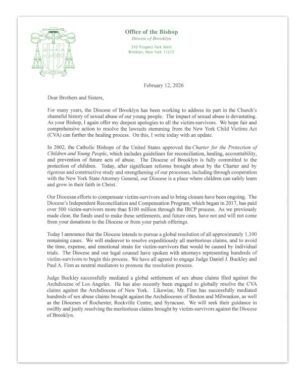
Over 90% of the 1,100 remaining claims are from more than 35 years ago, with most from the 1970s and the second-most from the 1960s, according to the diocese’s legal counsel. They further added that most of the cases were filed under the New York Child Victims Act, a 2019 state law that extended the statute of limitations for a survivor of child sex abuse in criminal and civil cases.
“We will endeavor to resolve expeditiously all meritorious claims, and to avoid the time, expense, and emotional strain for victim-survivors that would be caused by individual trials,” Bishop Brennan said in the letter, adding that the diocese and its legal counsel have spoken with attorneys representing hundreds of victim-survivors to begin the process.
Jeff Anderson and Associates, which represents over 200 victim-survivors who have brought cases against the diocese said Bishop Brennan’s announcement “offers a real opportunity for resolution and progress.”
“We look forward to the opportunity to work toward a resolution and will continue litigation as necessary,” the firm said in a Feb. 12 statement.
Since 2017, according to Bishop Brennan, the diocese has paid over 500 victim-survivors more than $100 million through its Independent Reconciliation and Compensation Program. Outside the program, the diocese has resolved about 100 more cases, according, to its legal counsel. Funding to resolve cases to date has typically come from asset sales, counsel explained.
Bishop Brennan said the diocese is “fully committed to the protection of children,” noting its adherence to the United States Conference of Catholic Bishops Charter for the Protection of Children and Young People and the diocese’s agreement with the State Attorney General to enhance prevention and investigation procedures.
“Today, after significant reforms brought about by the Charter and by rigorous and constructive study and by strengthening our processes, including through cooperation with the New York State Attorney General, our diocese is a place where children can safely learn and grow in their faith in Christ,” Bishop Brennan said.
For the current global resolution process, Bishop Brennan said the diocese, its legal counsel, and attorneys representing hundreds of victim-survivors have agreed to engage Judge Daniel Buckley and Paul Finn as “neutral mediators.”
Buckley previously mediated a global settlement of sex abuse claims filed against the Archdiocese of Los Angeles and has recently been tasked with globally resolving the claims against the Archdiocese of New York. Finn, meanwhile, has mediated hundreds of sex abuse claims brought against the Archdioceses of Boston and Milwaukee, as well as the Dioceses of Rochester, Rockville Centre, and Syracuse.
“We will seek their guidance in swiftly and justly resolving the meritorious claims brought by victim-survivors against the Diocese of Brooklyn,” Bishop Brennan said.
Anyone who is a victim of sexual abuse within the diocese is encouraged to call the confidential reporting line (888-634-4499), which connects directly to law enforcement authorities.
For information on how the diocese is dealing with clergy sex abuse, visit the website of the Office of Safe Environment and “Protecting our Children” on the Diocese of Brooklyn’s website.