This site uses cookies to store information on your computer. By using this site, you consent to the placement and use of these cookies. Read our Privacy Policy to learn more.
ACCEPT
It’s a walk Rose has taken for years. With a cross to proclaim her faith and gloves to protect her health, day after day, she stands outside of a Brooklyn abortion clinic.
Rose tells Currents News the key to being able to come back day after day, is to, “Never, never give up on the fact that we can reach these women. But we have to do it with love.”
Rose hasn’t given up, “What am I doing that’s more important, even if it’s just prayer, someone has to be there to pray for these women.”
She started praying years ago, with Monsignor Philip Reilly and the Helpers of God’s Precious Infants, a pro-life group that runs in the Diocese of Brooklyn. They’re working where they’re needed most.
New York City is often called the abortion capital of the country. Its where 50,000 of the states 80,000 yearly abortions happen. That’s according to the Susan B. Anthony List, a nonprofit that seeks to end abortion.
Three hours a day, four days a week, Rose stands here, fighting to change that.
It’s a calling that is not without its dangers. She has been threatened.
Rose says, “But then one time one of them says, you’re all alone. Who do you got here, you’re all alone. I said, I have Jesus, Mary and Joseph.”
It’s why Rose asked Currents News not to use her last name, a way to keep her safe.
But despite the dangers – she always comes back – driven by the success stories.
Rose explains, “But she came to the place two or three times, and then on the final visit she said, ‘I can’t do it.’ Praise the Lord, and that gives you encouragement. It doesn’t seem that you’re doing anything, but you never, never, never know.”
Standing quietly on the sidewalk, as women enter the center, she hands out rosaries and pamphlets with information for local pregnancy centers.
One of them – the Life Center of New York in Bay Ridge, Brooklyn.
Their executive director, Fred Trabulsi explains, “Since we are working with Rose in the last six months or more, we have had maybe, four turn arounds, through Rose’s instrumentation.”
Fred says when he looks at her, he sees a possible future saint.
There are unprecedented protests taking place in Cuba. The Diocese of Brooklyn’s Auxiliary Bishop Emeritus Octavio Cisneros knows first-hand about the brutal dictatorship that has had a grip on his homeland for more than 60 years.
Bishop Cisneros joined Currents News to talk about what’s ahead for the Cuban people in their fight for freedom and human rights.
Heavy police patrols in Cuba as the government tries to quell the growing civil unrest in the country. Brooklyn Bishop Ocativo Cisnero, a Cuban native, explains the dire situation there.
Pope Francis is still going strong on his road to recovery. His hospital release date, however, remains unknown.
Get-well wishes and prayers seem to have worked for both the Holy Father and an educator recovering from COVID-19.
A Catholic nun celebrates a milestone anniversary with a former student, turned priest!
Signum fidei – it means “a sign of faith” and for the last month, that’s what Ray Cosentino has been looking for as his younger brother Mike fights for his life against COVID-19.
“The fear of losing someone you love is scary and the whole process of not knowing what’s going to happen,” Ray said. “The stress and anxiety level, it’s been hard.”
The Latin phrase is the motto of St. Peter’s Boys High School on Staten Island. It’s the school where both Ray and Mike attended and coach football. It’s also where Mike serves as the school principal. Now, after weeks of being in a coma – Mike is awake.
“Him coming out of the induced coma has all happened in the last 48, 72 hours and it’s a huge relief,” Ray said. “You get excited, but you have to remind yourself he has a long way to go.”
During the most stressful time in their lives, Ray and members of his family have been coming to the school’s grotto to plant flowers, light candles and read the signs students have been leaving. More than a year after the 35-year-old father-of-four delivered a pandemic message of hope and strength to his students, the disease had Mike in its grips in a flash.
“Mike’s always on his phone, busy, responding to people,” Ray said. “I called and checked-in. Everything just led to him going to the hospital and when he got there, it was a real concern.”
Coming to the grotto to pray is what got the Cosentino family through. Now, they want to make the space more beautiful for others. They say it’s prayers from people they’ve never met that helped Mike out of the thick of his coronavirus battle and will hopefully bring him home.
“There’s been a novena that went on for nine days and there’s still a Zoom prayer every night,” Ray said. “What do you say to that? People from other schools, other neighborhoods that don’t know my family, what can you say to that? It’s unbelievable.”
Now Mike is getting stronger every day, but he’s not out of the woods yet. So his family continues to visit the grotto. Ray says the prayers and support from the St. Peter’s community have been life-changing: this is where he comes for a sign of faith.
It was a stroll down memory lane for Sister Mary Anthony Gracyalny and Msgr. Thomas Machalski as they walked through the property that used to house Holy Cross Catholic Academy.
Msgr. Machalski was a student and Sister Mary was his first grade teacher. It was her dream job.
“So in the eighth-grade we had to write a, ‘what do you want to do when you grow up?’ So I said, ‘I would like to be a teacher,’” the sister told Currents News.
Her dreams became a reality and Sister Mary did become a teacher and taught all over the world including 11 years in Peru.
“It’s great, I’ve met a lot of people,” she said. “A lot of kids are still writing to me from Peru.”
It’s not a surprise to Msgr. Machalski that her former students would want to stay in touch with her. He says at his school, she was beloved.
“There was no kindergarten here at Holy Cross at that time,” the monsignor said. “So that was our first experience with school. You know all the trial and trepidation and the crying and all those other things that go along with the trauma of leaving home and going to school, she was always very soothing and calming.”
Throughout the years, they went from teacher and student – to mentor and future priest – to friends. She and the rest of the Sisters of the Holy Family of Nazareth always provided support.
“From the first minute that I shared that I heard that call, the sisters were always there,” Msgr. Machalski said. “When I was in the seminary in Michigan, they wrote me cards, they wrote me notes. When I had my first Mass, they were out there in numbers, celebrating with me.”
After all the support he’s received throughout his formative years to becoming a priest, he’s finally able to give back by helping her to celebrate 70 years as a sister. How? Honoring her with a special Mass.
“I’m not sure how many priests have the opportunity to celebrate the Mass for the 70th anniversary of a sister’s religious profession,” Msgr. Machalski said, “and also that sister was their first-grade teacher.”
Thousands of anti-communist protesters in Cuba chanted, “Patria y Vida,” which translates to “homeland and life.” For those who take the risk of saying those words during protests, could end up being arrested by the government.
Those words were a stark response to a similar government phrase from when Fidel Castro was in power, “Patria O Muerte,” which means, “homeland or death.”
Across Cuba, Puerto Rico, Florida, Las Vegas and more, demonstrators took to the streets in a show of support, demanding access to COVID vaccines, food, and freedom. Thousands are calling for an end to the 62-year-old communist regime.
It started back in 1959 when Fidel Castro overthrew the military dictatorship that was in place. He quickly converted Cuba into a one-party communist system, ruling for almost fifty years. His brother Raul took over and recently handed the reigns to current president, Miguel Díaz-Canel.
Under Castro, Cuba’s highly contentious relationship with the United States led to the Bay of Pigs Invasion and the Cuban Missile Crisis, which brought the two countries to the brink of war.
Cuba’s economy and political freedoms have suffered ever since. Castro still holds a tight grip on the Cuban people.
That’s what makes these protests so shocking and unprecedented. Anti-government activity usually leads to immediate arrest. But in this police state, people are so hungry, and so angry that they’re speaking out against a government that for so long they’ve feared.
Cuba is facing its worst economic crisis in years, with tensions building for months over increased sanctions first imposed by the Trump administration. The pandemic only delivered an additional blow to the already ailing economy.
Unprecedented protests all over Cuba on Sunday, July 11, have elected U.S. officials speaking out. President Joe Biden called the unrest “a clarion call for freedom.”
“The United States stands firmly with the people of Cuba,” President Biden said.
The White House showed solidarity with those who are protesting government failures like ongoing food shortages, the cost of living and the handling of the COVID-19 pandemic.
People shouted “unite” and “freedom” as many clashed with police during the rare and historic protests. The country is in the midst of its worst economic crisis in decades. The pandemic brought Cuba’s tourism industry to a standstill. Now a quality of life crisis has driven protesters to call for Cuban President Miguel Diaz-Canel to step down.
Some lawmakers are hoping President Biden overturns Trump administration policies that tightened trade embargoes with Cuba. Others like New York Rep. Nicole Malliotakis, the daughter of a Cuban immigrant, disagree. She said President Obama’s plan to normalize relationships with Cuba would do more harm.
Malliotakis is one of 10 Cuban Americans serving in Congress.
“I hope this is the beginning of real change toward freedom and democracy on the island. President Biden, as leader of the free world, must do all he can to influence this change,” Nicole said in a statement, Monday, July 12.
Cuban Senator Marco Rubio took to Twitter and joined those calls for freedom.
“Socialism promises guaranteed food, medicine and income,” Marco said. “If you give up your freedom, when, as always, it fails to deliver, you don’t get your freedom back.”
Here in the Diocese of Brooklyn, Auxiliary Bishop Emeritus Octavio Cisneros, a native Cuban who came to the U.S. as a teenage refugee in the early 1960s without his parents, said people are fed up.
“The people are scared, the people are hungry, the people are fed up with the situation,” said Bishop Cisneros.
He said the oppression taking place in his home country is very much tied to the lack of freedoms faced by Cuban Catholics.
“Together with our prayers, we have to do something to make aware to the world community that this is going on,” he said. “That the vacation they experienced in Cuba was not reality and the reality can be seen now in what’s going on in the streets. They’ve been cut up by the socialist government.”
A beloved Brooklyn tradition is back and towering high above skies. The Giglio dances through the streets of Williamsburg to the delight of onlookers and the faithful!
Pope Francis made his first public appearance, post-surgery, looking healthy and happy as he prayed the Angelus from his hospital window.
The fight for freedom in Cuba as the country’s biggest protests in decades break out. The unprecedented crisis facing the Communist-run island nation.
As the U.S.-Mexico border continues to struggle with a massive influx of migrants, two people are hoping to make the journey easier for the youngest to bear – one bear at a time.
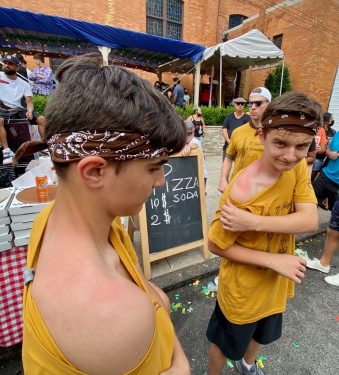
WILLIAMSBURG — Dominic and Michael Franco had certainly been out of their comfort zone, and they had the marks to prove it.
On Sunday, July 11, the brothers tugged at the collars of their sweat-drenched yellow t-shirts to proudly show how their necks and shoulders radiated the fiery color of sunburn. But this redness wasn’t from harmful rays.
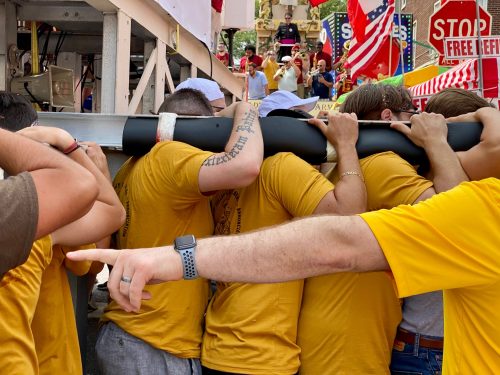
The teenagers had just joined dozens of men of all ages parading two massive floats on their shoulders, including the multi-story-high “Giglio” tower. The meeting of the ornately decorated tower and the replica boat comprise the “Dance of the Giglio” — the centerpiece ritual of the Feast of Our Lady of Mount Carmel & San Paolino Di Nola (St. Paulinus of Nola).
Italian immigrants and their descendants at Our Lady of Mount Carmel Parish in Williamsburg have celebrated this Italian-American classic since the late 1880s. That is, except for 1945 because of World War II and 2020 during the COVID-19 pandemic.
But on Sunday, thousands of people packed North 8th Street outside the church for the feast’s return to the Brooklyn neighborhood. Traditional Italian music, the aroma of grilled festival foods, and the rumbling of carnival rides filled the air.
It was the first time Dominic and Michael were among the “lifters,” following in the steps of their father, Philip Franco, a deacon for the parish and a lifelong resident of the neighborhood. They started the day lifting the boat and expected to switch over to the tower later in the day.
“It was like I thought it would be,” said 13-year-old Michael. “I was anticipating it was going to be a little easier in the beginning and then harder as you go on because everyone’s getting tired. Most of the lifters are, like, coming in and out. They’re taking breaks.”
Brothers Dominic (left) and Michael Franco show off the redness they gained as lifters who “danced” the Giglio, Sunday, July 11. The marks weren’t big enough to be considered “Giglio humps,” but the teens were proud of them, nonetheless.
Worth the Pain
In the dancing of the Giglio, the replica boat symbolizes the return of 5th-century bishop, St. Paulinus, to his beloved Nola, Italy, following his release from slavery.
Nearby, another crew was lifting the “Giglio” — a massive, ornately decorated tower symbolizing the affection citizens Nola felt for their bishop. St. Paulinus had exchanged his freedom for the release of women and children kidnapped by Vandal raiders and sold into slavery in Africa.
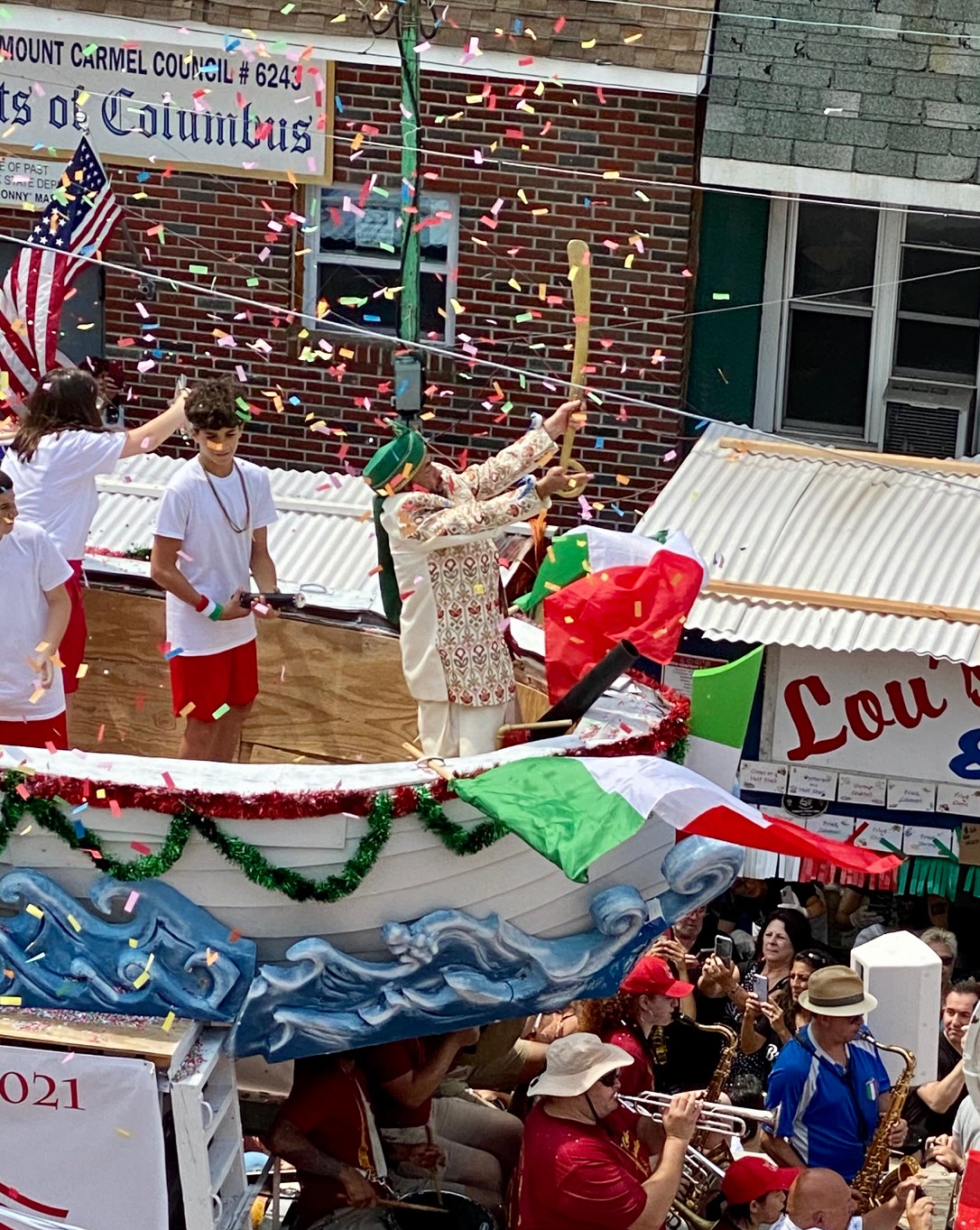
“Giglio” is the Italian word for lilies which, according to legend, is the flower that the people of Nola waved at St. Paulinus as the boat, commanded by a “Turk,” neared their shore.
Dominic Franco, 14, said he “definitely” wanted to sign up for another afternoon of sweat, grime, and muscle strain next year.
“It hurts, but it’s fun,” he said. “And it’s worth it — worth the pain — probably because we’ve been watching it our whole lives, and now we finally get to do it.”
A “lieutenant” directs some of the 125 “lifters” as they maneuver the replica boat during the “dancing” of the Giglio, Sunday, July 11. The dance is a cornerstone event of the annual Feast of Our Lady of Mount Carmel & San Paolino Di Nola, hosted by the parish in Williamsburg. (Photo: Bill Miller)
Msgr. Jamie Gigantiello, pastor of Our Lady of Mount Carmel Parish, knows the pain, having helped to hoist the Giglio in years past. This year the tower, at two tons and 80 feet tall, needed “125 strong men to lift it,” he said.
Many of them have moved out of Brooklyn but return to the feast, which is a main fundraiser for the parish.
“Having a feast this year is wonderful in many ways,” Msgr. Gigantiello said. “So many people we didn’t see last year because we didn’t have the feast — we’re seeing again. It’s great to see so many wonderful familiar faces.”
The dancing of the tower and boat toward each other commemorate that reunion, albeit on the shoulders of the lifters. The Franco brothers said they believed they were the youngest in the group. Most appeared to range from the 20s to 50s, although a couple admitted to being in their 70s, like Sal Guagliata of New Jersey.
“I grew up two blocks away,” he said. “I come here a lot, but I’m always here for the feast. I remember coming here when I was 3 years old, holding my father’s hand. It’s home.”
Being a lifter, he added, is a family tradition first started by his grandfather, followed by uncles and cousins.
“I’m totally convinced that this feast kept Williamsburg together,” Guagliata said.
A Joyful Noise
The festivities began Sunday at 11:30 a.m., with Mass celebrated by Auxiliary Bishop James Massa.
The entrance song was “When the Saints Go Marching In,” a rousing brass rendition performed by the Giglio Band. Meanwhile, a life-size statue of St. Paulinus was jubilantly shaken up and down by the men carrying it down the aisle.
Lifters, dressed in yellow or brown t-shirts and bandanas, joined parishioners in hearty applause and cheers. Bishop Massa urged the enthusiasm with his opening declaration, “Let us make a joyful noise unto the Lord!”
In his homily, the bishop honored the parishioners’ rich heritage as the descendants of immigrants.
“This feast always evokes, in us, gratitude for our grandparents and great grandparents, who were the first to carry the Giglio,” Bishop Massa said. “We stand, always, on the shoulders of these giants — women and men — who have left the comfort zones of their native towns back in Italy and from other countries.
“They poured themselves into a new life here in New York where they often — let’s face it — were treated poorly and unjustly.”
Immigrants leaving the loving embrace of their families and villages resonated throughout the homily.
Bishop Massa said the feast reminds him of his own grandfather, who left Italy by himself at age 12.
“His story captures a quality of character that we do well to honor in many of our ancestors,” the bishop said. “He traveled by boat in steerage, knowing absolutely no one except the cousins who awaited him on his arrival in New York Harbor. He left the comfort zone of his village with little more than the shirt on his back, a few letters from the relatives, and a pile of dreams about a new life in America.”
Bishop Massa said his grandfather started a bus company in Bayonne, N.J., raised a family of seven, and contributed to his community and parish. These rewards, the bishop said, “were the results of having heard a call from God to leave his comfort zone and venture into the unknown, with only the promises of faith to console him.”
The Story of Everyone Here
Such courage is characteristic of immigrants but also “a pervasive message or theme in the Bible,” Bishop Massa said.
For example, Bishop Massa pointed to the Gospel reading for Sunday’s Mass, which described how Jesus sent his disciples out of their comfort zones and into the mission field with no provisions or money — only the authoritative but loving and encouraging voice of their savior (Mark 6:7-14).
“What comfort zones have we been made to leave?” the bishop asked. “What comfort zones do we have yet to leave? You need to trust God and hear his authoritative voice that says, ‘You can do it.’
“Our immigrant forebears, I am convinced, heard that encouraging voice that summoned them to Brooklyn.”
After the Mass, Bishop Massa took a moment on the church’s steps to discuss the homily.
He said the immigrant heritage was on full display Sunday as the feast attendees honored their memories of parents, grandparents, and even older generations.
“This story,” the smiling bishop said, as the feast gained momentum around him, “is the story of everyone here.”
The feast continues through Sunday, July 18. The annual procession of the statue of Our Lady of Mount Carmel throughout Williamsburg was scheduled for 4 p.m. Friday.
Carmine Caggiano portrayed the “Turk,” Sunday, July 11, for the Feast of Our Lady of Mount Carmel & San Paolino Di Nola in Williamsburg. The “crew” included his niece and nephew, Joseph Renna, age 12, and MaryAnn Renna, 14, along with Rocco Petronella, also 14.
VATICAN CITY (CNS) — Pilgrims and well-wishers gathered at Rome’s Gemelli hospital to greet Pope Francis as he made his first public appearance in a week after undergoing intestinal surgery.
Appearing on the 10th floor balcony of his suite of rooms at the hospital July 11, the pope was greeted with applause and shouts of “Viva il papa” (“Long live the pope”) from the crowd that stood under the scorching midday sun to see him.
“I thank you all,” the pontiff said. “I have felt your closeness and the support of your prayers. Thank you very much.”
Pope Francis arrived at Gemelli hospital July 4 to undergo “a scheduled surgical intervention for a symptomatic diverticular stenosis of the colon,” the Vatican said. The pope has recovered steadily from his surgery and resumed working from the hospital.
Among the well-wishers outside the hospital was Liliana Valina who, like Pope Francis, is a native of Argentina living in Rome.
Draped in the Argentine flag after the country’s July 10 win against Brazil in the Copa America soccer championship, Valina told Catholic News Service that she was there “because I care for this pope very much and not just because he’s from Argentina like me.”
“I think he tells Jesus’ message in a clear way, even on things that are uncomfortable for some,” she said. “I came here hoping that he recovers soon, that he be healthy.”
When asked what she would tell her fellow countryman if she could speak directly to him, Valina said: “Never feel alone because you have God and you have many people who love you and are with you.”
Marlene Barbosa, a native of Peru living in Rome, also was outside the hospital with her husband, Maximo Lopez, as well as her mother, Susanna Morante, who traveled from Washington, D.C., to be with her family and have a chance to see the pope.
“We wanted to see him and receive his blessing because we are Catholic, we are believers and through prayer, we have been close to the pope in these days in which his health has been delicate,” Barbosa told CNS.
“We are with him, we are always praying for him so that he will recover completely,” she said. “We love him, all of Peru loves him and the whole world loves him.”
In his address, the pope reflected on the Sunday Gospel reading from St. Mark, in which Jesus sent out his disciples to anoint the sick with oil and heal them.
The oil, he said, not only represents the comfort given through the sacramental anointing of the sick, but also symbolizes “the closeness, the care, the tenderness of those who take care of the sick person.”
“It is like a caress that makes you feel better, soothes your pain and cheers you up. All of us, everyone, sooner or later, we all need this ‘anointing’ of closeness and tenderness, and we can all give it to someone else, with a visit, a phone call, a hand outstretched to someone who needs help,” he said.
Pope Francis said that his time in the hospital gave him the opportunity to experience “once again how important good health care is” and that free, universal health care, especially for the most vulnerable, is a “precious benefit (that) must not be lost.”
Acknowledging that some hospitals run by the church face the threat of closure “due to poor management,” the pope said the Catholic Church’s vocation “is not to have money; it is to offer service and service is always freely given.”
“Do not forget this: save free institutions,” he said.
Before praying the Angelus prayer with the faithful, Pope Francis expressed his “appreciation and encouragement” to the doctors, nurses and staff at Gemelli hospital. He also asked for prayers for the patients, especially the children, at the hospital, several of whom stood on the balcony with him.
“Why children suffer is a question that touches the heart. Accompany them with prayer and pray for all those who are sick, especially for those in the most difficult conditions,” the pope said. “May no one be left alone, may everyone receive the anointing of listening, closeness, tenderness and care.”