The Summer of Nuptials: Wedding Vendors See Big Boom in Business as New York Reopens

By Emily Drooby

New York makeup artist Sharon Becker was traveling all weekend for a wedding gig. Once she got home, instead of a break, she had to prepare for another job.

“The last month since weddings picked up again has been totally bonkers, completely insane,” Sharon said. “I don’t think I’ve ever felt something like this before and I’ve been doing this for 10 years now.”

After the pandemic, the busy schedule is welcomed. She owns her own company, SB Beauty. 

“It feels great,” Sharon added. “I’m so excited to be working again!”

Sharon is not alone. Wedding vendors across the city have seen a boom in business.

According to The Wedding Report, 42 percent of weddings originally scheduled in 2020 were moved to a date this year.

On top of that, with COVID restrictions lifted in New York, people can finally throw bigger weddings.

“Our phones have been ringing off the hook,” said Benjamin Gold. He’s the co-founder and president of the NY Food Truck Association.

They have 75 members with over 125 trucks.

“And they’re booked pretty much every weekend,” Ben explained.

Food trucks have become a popular option for wedding food.

In 2019, the association had anywhere from 30 to 40 percent of their trucks booked on the weekend. In 2020, during the pandemic, that number dropped down to below five percent. Now, that number is close to 95 percent.

“I mean there’s still going to be a lot of scars for a long time to come,” Ben said, “but this definitely helps get over that pretty quickly.”

Christian Rada is the Director of Marriage, Family Formation, and Respect Life Education for the Diocese of Brooklyn. Even he has seen an increase in pending marriages too.

“I’m seeing an increase in couples going to Pre-Cana.”

Couples are heading back to the church altar.

“Couples now want to get married inside the church. They want to have family and friends gather together to celebrate this wonderful occasion of two people coming together and asking for God’s blessing,” said Christian.

The summer of nuptials. That means more marriages, more families and more business for wedding vendors: all bright spots coming ahead after a difficult year.

Sacred Heart Catholic Academy Students Win Scholarship for Their Inspiring Bond

By Jessica Easthope

Izzy and Grace are inseparable – but they’re nothing like other best friends.

Izzy leans on Grace, when they’re walking down the stairs or down the hall at Sacred Heart Catholic Academy in Bayside, Queens. That’s because for Izzy, Grace is her caretaker.

“I usually walk with her and hold on to her, or if I can’t see something, she’ll read it to me and sometimes people aren’t always willing to do that,” said Izzy Gamarra, who is considered legally blind.

For the girls, there’s nothing special about their friendship – navigating the world together is all they’ve ever known. Izzy was only seven years old when she was diagnosed with a brain tumor that took her sight. That was when Grace took on a new role in her life.

“I can kind of see when she’s struggling most of the time and when I can’t, you always tell me, which I really like,” Grace said.

Arm in arm, Grace and Izzy are leaving the place where their friendship began and starting a new chapter together: attending high school at Holy Cross in Flushing, Queens.

Jeanine Rana, a faculty member and alumna of Sacred Heart Catholic Academy spoke about the importance of Catholic education.

“That’s what I grew up with, in this building and after all these years,” Jeanine said. “Catholic school is still instilling good and love in children.”

Over the last year, Jeanine was inspired by Grace and Izzy’s bond. Still in touch with her Sacred Heart classmates from more than 30 years ago, Jeanine reached out to tell them about the girls and within hours, they raised more than $2,000 dollars. The alumna decided to give the funds to the girls as a surprise scholarship at graduation.

“We wanted them to feel what we feel and hope and pray that 30-something years later, they can do the same for others,” she said.

The girls were blown away, but for their moms, it was a moment of pride.

“Grace had really took on that role very young, I think without realizing it, and I know when Izzy is out of the house with Grace, I know she’s safe,” said Izzy’s mom, Danielle Chase. “You can’t fake what Grace does.”

“She was given this gift of Izzy earlier than some people get it,” said Peggy McKenna, Grace’s mom. “That’s really how we look at it and treat this situation – it really is a gift.”

The girls began living in the same two-family home a few years ago, but getting sick of each other was never an option.

“I tell her everything, she’s my go-to person,” Grace said. “She understands what I’m trying to say because sometimes I don’t want to say it, but she still gets everything.”

You might think Izzy needs Grace, but if you look closer – you realize – just like any other best friend, they need each other.

Catholic News Headlines for Friday, 6/18/21

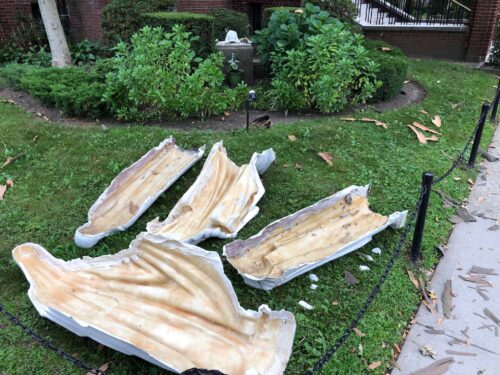
Mother Cabrini is back home in Brooklyn. The statue is inspiring others to be more like her in the “Diocese of Immigrants.”

U.S. Bishops get the go-ahead to draft a document on the Eucharist.

A major win for religious freedom — the Supreme Court sides with a Catholic organization over who it can adopt children to.

A Catholic family turns its loss into hope for the next generation.

U.S. Bishops Debate Communion Doc, Vote To Be Revealed Today

By John Lavenburg and Currents News Staff

NEW YORK — In a spirited two-hour debate Thursday, both critics and champions of a U.S. bishops’ doctrinal committee proposal to draft a document on the Eucharist cited timing and potential disunity as reasons why they were for, or against, the project.

More than 40 bishops offered opinions on the proposal at Day Two of their annual spring assembly. Afterward, each bishop submitted their vote to approve or deny the proposal. The final tally will be revealed this afternoon.

On Thursday, some of the nation’s top prelates were among the proposal’s biggest critics.

“In my nearly 38 years as a member of this episcopal conference, I cannot recall a similar moment,” said Cardinal Wilton Gregory of Washington. “The choice before us at this moment is either we pursue a path of strengthening unity amongst ourselves, or settle for creating a document that will not bring unity, but may very well further damage it.”

The cardinal added that the bishops need to spend time “in candid, straightforward conversation together to strengthen that unity within our conference” before taking the next steps towards a statement or plan of action.

If the proposal is approved, the doctrinal committee will begin developing the document with input from a number of other USCCB committees and bishops. The final document will then be discussed and voted on for approval at November’s fall assembly, where it needs a two-thirds majority.

Cardinal Joseph Tobin of Newark, like Cardinal Gregory, made the case it’s too soon.

“Voting in the affirmative will produce a document, not unity,” Cardinal Tobin said. “Voting against it will allow us to work together in dialogue to forge a broad agreement on the serious questions embedded in the issue of Eucharistic worthiness.”

In a pre-recorded address to open the discussion on the proposal, Bishop Kevin Rhoades of Fort-Wayne South Bend, the doctrinal committee chair, explained the committee’s reasoning behind the document, its focus, and proposed contents.

Bishop Rhoades identified the faithful’s absence from the pews through the pandemic and a “pluralistic environment” where the truth about the Eucharist can get lost as two reasons why the committee finds it important to reaffirm the meaning of the Eucharist. He also cited national surveys that indicate Catholics believe the Eucharist to be only a symbol.

The USCCB chairman also made it clear that the document was never considered by the committee to be about any one individual or category of sinful behavior. He said the committee ultimately decided against formulating a national policy on the worthiness to receive communion.

There would be, however, a proposed subsection of Eucharistic consistency in the document, Bishop Rhoades said, which addresses actions “that inflict damage to the honor due the sacrament, or cause scandal to the faithful.”

Despite his claims otherwise, the combination of that subsection and previous statements from other bishops about barring pro-choice Catholic politicians from communion — particularly President Joe Biden and Speaker of the House Nancy Pelosi — has led a number of bishops to maintain a belief that the document is politically motivated.

“Those who are insisting that we need to do this immediately really reveal what this is about,” Cardinal Blase Cupich of Chicago said. “They want us to make statements and do something about politicians who hold positions that are contrary to our teaching.”

Bishop Robert Coerver of Lubbock questioned if the timing is politically motivated.

“There seems to be a rush to this,” Bishop Coerver said. “I can’t help but wonder if the years 2022 and 2024 might be part of the rush, and I think we need to be really careful not to get embroiled in the political situation.”

Cardinal Tobin warned political motivations are a grave mistake.

“Any efforts by this conference to move forward with a categorical exclusion of Catholic political leaders from Eucharist based on their public policy positions will thrust the bishops of our nation into the very heart of the toxic partisan strife, which has distorted our own political culture and crippled meaningful dialogue.”

On the other side of the debate Archbishop Joseph Naumann of Kansas City, chairman of the USCCB pro-life activities committee, said it’s not the bishops but certain politicians that have created this controversy, noting Biden’s commitment to expanding abortion rights.

Bishop Liam Cary of Baker called it an “unprecedented situation” that there’s a Catholic president who opposes the teaching of the church. Bishop Donald Hying of Madison said he speaks with Catholics daily confused about Biden’s Catholicism.

Other perspectives from bishops on both sides of the debate weren’t political. There was also widespread agreement that if this proposal is approved, in-person regional meetings should take place for bishops to further discuss the document.

In support of the draft, Cardinal Nicholas DiNardo of Galveston-Houston and others made the point that there will be “further ways to have serene dialogue and conversation” with a draft to reference, which is why it should be developed.

Bishop James Wall of Gallup made what he called a “plea on behalf of a poorer diocese.”

“A diocese such as mine we don’t have the resources or maybe send away people to get advanced degrees in different things like that,” Bishop Wall said. “So, a lot of things we do we rely on the work of the conference and committees and documents and statements that come from the conference.”

Others opposed, such as Cardinals Gregory, Tobin, and Cupich wanted to wait until November so the discussion can be in person. Many also said they would support the proposal if the subsection on Eucharistic consistency was removed.

Archbishop John Wester of Santa Fe presented an alternative pastoral reflection called “Welcome Home” built on positivity and unity.

“It would be an invitation back to the Eucharist,” Wester said. “It could be an invitation to rediscover what unites us, to give us strength and sends us forward to proclaim the good news.”

U.S. Conference of Catholic Bishops Debate Document on the Meaning of the Eucharist

By Jessica Easthope and Currents News Staff

On Thursday, the big question was finally discussed at the U.S. Bishop’s spring assembly: whether or not to draft an official document about the Eucharist.

“We are all concerned that the faithful’s absence from parish life may have resulted in a loss of what it means to be a Eucharistic people. We worry that many of our faithful may not return to the Eucharistic celebration,” said Bishop Kevin Rhoades, who presented the issue before the conference.

The issue took center stage and hours of conversation. It arose in the wake of recent polling that showed many Catholics don’t understand and or don’t believe that the consecrated bread and wine become the literal body and blood of Jesus Christ.

Opinions among the bishops varied drastically. Those in favor of drafting the document said it would serve as a unifying document meant to teach about enhancing the love and centrality of the Eucharist – they underscored that it’s not meant to be political.

“A document like this, a pastoral teaching document would be something we would want to come together and issue,” said Archbishop William Lori who was in favor of the document.

But those not in favor of drafting a document argued the debate surrounding the issue was vague. They also worry it could potentially exclude Catholics at a time when the Church is working to bring people back to Mass after the pandemic.

“The bishops now want to talk about excluding people at a time when the real challenge before them is welcoming people back to the regular practice of the faith and rebuilding their communities,” said Cardinal Blase Cupich, who spoke out against the document.

The tally on whether or not to draft the document is expected Friday, June 18. The document will not ban anyone from receiving the sacrament, ultimately that decision will be up to an individual bishop and not the conference. If the document is developed it will most likely take several months to be published.

Catholic News Headlines for Thursday, 6/17/21

Day two of the United States Bishops meeting – calls for unity as they debate that communion document.

In a major ruling the Supreme Court sides with a Catholic agency over same-sex foster care.

Juneteenth is officially a federal holiday – President Joe Biden signing the measure honoring when the last slaves in the U.S. learned about their freedom.

A solemn anniversary for three FDNY widows who lost their husbands 20 years ago today.

Three Fallen Firefighters Remembered During Mass After Fatal “Father’s Day Fire” 20 Years Ago

By Emily Drooby

Remembering three of New York’s bravest: Harry Ford, Brian Fahey and John Downing. They were heroes and all killed fighting a fire on June 17, 2001.

Their three widows, families, friends, and fellow firefighters gathered at St. Sebastian’s in Woodside, Queens on the 20th anniversary of their deaths to remember the three Catholic men.

The men’s lives were taken while fighting what has now been dubbed, the “Father’s Day Fire.” Lieutenant Nicholas D’Alessandro was there.

“Well, it was a beautiful day, Sunday, Father’s Day,” Lt. Nicholas said. “We were all anxious to go home obviously.”

Unfortunately, that’s not what happened. Instead, Lt. Nicholas and many other firefighters were called to an Astoria, Queens hardware store where a five-alarm fire was blazing. Harry, Brian and John were killed in an explosion.

On Thursday morning, wreaths were laid in remembrance.

Of the loss, Lt. Nicholas said, “The fire department is one big family, all five boroughs, and you feel the loss sincerely in your heart, and it never goes away.”

Following the wreath-laying, members of the fire department filled the pews of St. Sebastian’s, where John Downing was a parishioner for a Mass. A place for both family and friends to reflect.

“Brian was a cheerful, jolly guy, very knowledgeable,” explained Lt. George Torres “He was a natural born teacher.” Lt. George is from Rescue Four –  just like Harry and Brian.

“It’s really heartwarming,” said Father Patrick West. As the administrator of St Sebastian Church, he celebrated the Mass and explained why the event was touching.

“To see how many people from the parish came out to remember in thanksgiving for the sacrifice they made in protecting us,” Father West added.

All in all, they remembered those who made the ultimate sacrifice to protect New Yorkers.

Supreme Knight Patrick Kelly Says Knights of Columbus Committed to Getting Catholics Back to Church

By The Tablet and Currents News Staff

NEW HAVEN, Conn. — At his installation at St. Mary’s Parish on June 11, the new Supreme Knight of Columbus called on the Knights and faithful “to dedicate ourselves to Christ and the Eucharist.”

New Supreme Knight Patrick Kelly consecrated his administration to St. Joseph, noting that the saint was the protector of Jesus, and called on the Knights to do the same in protecting the Eucharist.

“The example of St. Joseph teaches us how to be Knights of the Eucharist,” Kelly, the first new Supreme Knight to be installed in 20 years, said in his installation address. “He was the guardian of the first tabernacle — beginning with Mary herself when she bore Christ in her womb, and then in the home where he lived with Mary and Jesus.

As Knights, we too are called to have special reverence for Christ’s real presence,” Kelly added. “The more we dedicate ourselves to Christ in the Eucharist, the more we will be a sign of unity in an age of division and disbeliefs.”

Kelly, who previously served as Deputy Supreme Knight, was elected to the position of Supreme Knight in March. He and other elected Knights officials were installed at a meeting of state deputies, attended by leaders of the Knights from each U.S. state and around the world.

The ceremony began with a Mass celebrated by Archbishop William Lori of Baltimore, the Supreme Chaplain of the Knights.

Archbishop Lori said “it is incumbent upon us as Knights of Columbus, upon you as lay leaders in the Church,” to promote devotion to the Eucharist in their communities.

The Knights of Columbus is one of the world’s leading fraternal and service organizations, with two million members worldwide in more than 16,000 parish-based councils.

The newly installed Supreme Knight pledged that the Knights will continue to be a sign of unity by standing for the truth and that the truth is grounded in the Eucharist.

“We know that Jesus Christ is really, truly present — body, blood, soul, and divinity — in the Blessed Sacrament,” Kelly said. “Committed to our principle of unity, let us strive to serve Christ in the Eucharist.”

U.S. Bishops Open Spring Meeting With Debate Over Eucharist Document

By John Lavenburg and Currents News Staff

NEW YORK — A motion to give individual bishops unlimited time to speak on a U.S. Bishops Conference doctrinal committee proposal to draft a document on the Eucharist was ultimately denied on Day One of their spring meeting, but not before a spirited, near hour-long, debate on the timing of the proposal.

Archbishop Mitchell Rozanski of St. Louis made the motion Wednesday during what is typically a routine vote on accepting the agenda. Supporters of the motion made the case that every bishop deserves to have their voice heard on the controversial proposal. Meanwhile, those opposed to the motion called it a “delaying tactic,” and made the case that if the proposal is approved a robust discussion will take place when the drafted document is voted on in the future.

“This topic and its implications are so far-reaching and putting limits on the amount of time given for our discussion will not help us,” Archbishop Rozanski said. “I urge that this opportunity be offered for all who wish to speak, that the fullest discernment be achieved at our meeting.”

In the end, 59% of the bishops voted down the motion.

About 20 bishops made their case for or against the motion and the proposal to draft the document, before Archbishop José Gomez of Los Angeles, president of the USCCB ended the discussion to move the meeting along.

Among the supporters of the motion were Bishop John Stowe of Lexington and Cardinal Blase Cupich of Chicago, who both brought up the political component of the months-long debate. Particularly, that the debate surrounding the document both inside and outside of the episcopacy have focused on President Joe Biden — a Catholic and pro-abortion Democrat — and other pro-abortion Catholic public figures and their worthiness to receive communion.

Both prelates were also among the nearly 70 bishops who signed a letter to Archbishop Gomez last month to delay the vote on the proposed document until the bishops gather again in person in November.

“Rather than see this as a delay tactic, it seems that some of the brother bishops want to rush this discussion and to focus the emphasis on a teaching document on the Eucharist about whether our Catholic president is able to receive communion,” Bishop Stowe said.

Cardinal Cupich said the views and statements made by members of the Catholic hierarchy in the U.S. has “colored the perception of this document.” He and other bishops in support of the motion also made the case that the conference isn’t following recent advice of Cardinal Luis Ladaria of the Vatican’s doctrinal to have an “extensive and serene” dialogue amongst themselves and with Catholic politicians in their dioceses before moving forward.

In a conversation with The Tablet at the conclusion of Wednesday’s meeting, however, Bishop Michael Olson of Fort Worth, who serves on the doctrinal committee, believes they’ve done what Cardinal Ladaria counseled them to in the letter.

“When the letter Cardinal Ladaria came to us, in a sense, we were either already doing what he counseled us to do and what we’ve been doing for 25-30 years as bishops and as a conference with regard to dialogue,” Bishop Olson said. “I appreciate the cardinal’s letter. It affirms the good work we were doing, and also it offers us clarity and a structure now to continue this dialogue in the development of the document itself.”

Bishop Olson also said the document isn’t political.

“What we’re doing as bishops here is not a political statement,” he said. “Our main point is a doctrinal understanding and better grasp of the Eucharist that will go hand in hand with the ongoing work of the evangelization committee on the Eucharistic Revival.”

Bishop Thomas Paprocki of Springfield in Illinois told The Tablet if the motion passed it would’ve almost amounted to a sort of “episcopal filibuster.” He said it’s important to vote on the proposal so that there is a draft ready for a full discussion on the topic come November.

Archbishop John Wester of Santa Fe was among the bishops in support of the motion. Part of his reasoning is a belief that Zoom isn’t the proper place to take up complicated issues. But he also believes a document on the “beauty and importance of the Eucharist” and Eucharist coherence about who can receive the Eucharist are separate issues that “shouldn’t be conflated.”

“Go ahead and do something on the Eucharist but don’t include this other issue because they’re completely different issues,” Archbishop Wester told The Tablet.

“It’s very difficult, complicated, nuanced, neuralgic and takes a lot of thought,” he added about Eucharist coherence. “Before we really take all that up we need to talk among ourselves about the main points of how we come together.”

Outside of the debate on the doctrine committee’s proposal were calls for unity from both Archbishops Gomez and Christophe Pierre, the Apostolic Nuncio to the United States.

“It’s not realistic to expect the church to stay immune from the pressures of division,” Archbishop Gomez said in his presidential address. “Those pressures are all around us. So, we need to guard against the temptation to think about the church in simply political terms.”

In part of Archbishop Pierre’s pre-recorded speech, he told the bishops simply, “If you want to go fast, go alone. If you want to go far, go together.”

The discussion and vote on whether or not the doctrinal committee will draft the document on the meaning of the Eucharist in church life is scheduled for Thursday afternoon on Day Two of the three-day spring meeting.

Catholic News Headlines for Wednesday, 6/16/21

An hours-long landmark summit between President Joe Biden and Russian President Vladimir Putin — several major issues discussed.
U.S. bishops kick off their spring assembly debating key issues for the Church — including who should receive the Eucharist.
A first of its kind in New York City. We’ll take you to the perpetual adoration chapel that will soon open to serve the faithful.