Currents News Staff
Russian forces are expanding their offensive in Ukraine to the west for the first time.
Meanwhile, Pres. Biden announced the US, along with the G7 and European Union, will move to suspend normal trade relations with Russia.
Currents News Staff
Russian forces are expanding their offensive in Ukraine to the west for the first time.
Meanwhile, Pres. Biden announced the US, along with the G7 and European Union, will move to suspend normal trade relations with Russia.
Currents News Staff
Commuters are continuing to pay more at the pump to fill up their tanks as gas prices continue to rise.
One gas station in California was charging $7.35 per gallon for regular unleaded.
While prices at most stations have not jumped that high, commuters across the country are feeling the stress.
Currents News Staff
We’re learning more about that boat carrying hundreds of Haitian migrants to Florida over the weekend.
U.S. Customs and Border Protection now says it was not a case of human smuggling.
They determined this by examining the type of boat used, an old wooden boat. Smugglers typically use speedboats or cabin cruisers.
Some of the migrants who tried to swim to shore needed medical assistance.
One person who knows all about the plight of Haitian migrants and the treacherous journeys many of them take to get to the U.S. is Vanessa Joseph.
She’s an immigration attorney at Catholic Legal Services in Miami and joins Currents News.
There’s outrage after the Russian attack on a Ukrainian maternity hospital that killed three people including a child.
Students at St. Mark’s Catholic Academy in Sheepshead Bay are thinking of their peers in Ukraine.
Eighth graders at St. Joseph The Worker Catholic Academy are showing off their robotics skills.
Currents News Staff
The latest round of talks between Russia and Ukraine ended without progress Thursday.
The meeting held in Turkey failed to establish a 24-hour ceasefire or humanitarian corridor for civilians.
These talks happened at the same time U.S. Vice President Kamala Harris met with Polish officials in Warsaw to assure America’s commitment to its NATO allies, and as the U.S. House of Representatives passed a massive bill that includes billions in aid to Ukraine.
Currents News Staff
WASHINGTON (CNS) — Just a day after a U.S. House commission’s hearing on holding Russian President Vladimir Putin accountable for “war crimes and aggression against Ukraine,” his military forces carried out an airstrike on a maternity hospital in Mariupol in the East European country.
The March 9 attack, which left three people dead, including a child, and injured 17 others brought condemnation from around the world. AP reported those injured included “women waiting to give birth, doctors and children buried in the rubble.”
“You will definitely be prosecuted for complicity in war crimes,” Ukrainian President Volodymyr Zelenskyy said in a video address directed at Putin. “And then, it will definitely happen, you will be hated by Russian citizens — everyone whom you have been deceiving constantly, daily, for many years in a row, when they feel the consequences of your lies in their wallets, in their shrinking possibilities, in the stolen future of Russian children.”
In Washington, U.S. Rep Chris Smith, R-N.J., as co-chair of the Tom Lantos Human Rights Commission, presided over the March 8 hearing, the first in the House of Representatives over holding the Russian leader accountable for his invasion of Ukraine that began Feb. 24.
“We are here to recommit to assisting Ukraine during its darkest hour and to honor those who are sacrificing their lives defending their beloved country from an unprovoked, barbaric invasion by Putin and the Russian Federation,” Smith said in opening the hearing. “We are also here to hold Putin and Russian officials to account.”
He added that those gathered for the hearing joined “the free world in honoring the extraordinary courage and tenacious leadership” of Ukraine’s president.
What is happening to Ukraine is “the largest and most lethal attack in Europe since World War II, and the world has been shocked by the massive death and destruction unleashed by Putin,” Smith said.
He compares Putin’s action’s to Adolf Hitler’s invasion of Poland in 1939, which began World War II.
“President Putin — and others responsible for this ongoing and ever-expanding mass murder, war crimes and crimes against humanity — must be held to account and prosecuted for their crimes,” the Catholic congressman added.
“The time to act for justice and accountability is now,” Smith said. “Justice delayed is justice denied.”
Smith has introduced a House resolution supporting the “investigation and prosecution of the crime of aggression and other international crimes committed by officials of the government of the Russian Federation against the government and people of Ukraine.”
The resolution also calls on President Joe Biden to direct the U.S. ambassador to the United Nations “to use the voice, vote and influence of the United States to immediately promote the establishment of an appropriate regional or international justice mechanism to investigate and prosecute possible international crimes” stemming from the invasion.
It also urges Biden to convene “the world’s democracies for the purposes of establishing such an international justice mechanism” as soon as possible.
Among the witnesses testifying at the hearing was David Kramer, managing director of global policy for the George W. Bush Institute and former assistant secretary of state for democracy, human rights and labor.
Echoing Smith, he called the current situation in Ukraine the “gravest crisis in Europe since WWII” and emphasized the importance of swift and united actions by the international community.
“The refrain ‘never again’ emerged in the wake of the Holocaust, and Ukrainians are wondering whether that pledge applies to them,” said Kramer.
Among other witnesses were David Crane, founding chief prosecutor for the U.N. Special Court for Sierra Leone, and Jane Stromseth, the former deputy to the U.S. State Department’s ambassador-at-large for global criminal justice.
Crane spoke of the need for global “leadership” to “bring the world together” and called for “a tribunal that has an appropriate mandate.”
“Strongmen around the world are watching, like crocodiles, as to what we do about the international crimes committed by the Russian invasion of the Ukraine,” said Crane.
“Let’s go and put some bad guys in jail, shall we?” he said.
Stromseth said that “international law is on our side … the question now is how the international community will respond.”
She added that “failure to stand up to those who order and commit such crimes will only embolden their sense of impunity” and emphasized “a strategy of mutually reinforcing accountability — that is, accountability through multiple complementary mechanisms grounded in the fundamental principles of international law.”
Whichever mechanism proves to be most effective at holding Putin accountable, Smith said “we’ll find a way to get it done.”
“Failure to do so would be gross negligence,” said Smith.
By Jessica Easthope
At St. Joseph the Worker Catholic Academy it’s robots to the rescue, on a mission to solve a problem that affects more than 64 percent of Americans – package theft.
“The average person always experiences some kind of difficulty and package theft is one of those difficulties we could solve with our technology,” said eighth grader Edmon Saleeb.
The school’s eighth grade robotics team is on its way to the First Lego League Challenge city championship. The theme of the competition is cargo connect – they were asked to find a problem and then build and program a robot that could solve it.
The team didn’t have to look farther than their front doors.
“I knew it was like a global thing happening and since I’ve experienced it personally I guess I wanted to get really into it,” said team member Kellianne Wilson.
In 2021 a survey by SafeWise found that 210 million packages vanished from porches all across the country, but the team’s solution – is air tight. They came up with a QR code scanner that would allow delivery people into a mailbox or locker outside of a home instead of having to go in.
Robotics coach and technology teacher Lisa Nitzsche says the team is letting faith and technology lead the way.
“It really ties in with caring for others and thinking of others,” she said.
And this team is the total package.
“For Edmon he’s able to calculate how many degrees the robot should go and I mostly do the writing,” said Kellianne.
They’re preparing for the competition and for life after elementary school.
“A lot of the robotics skills they’re learning, the teamwork, the problem solving, using different technologies, doing the research is preparing them for further from here,” said Lisa.
The team will be competing against 75 other teams in the citywide championship on March 13.
St. Thomas Aquinas
“The greatest kindness one can render to any man consists of leading him from error to truth”

Nuns from the Order of St. Basil the Great are pictured Feb. 22, 2022, during a pilgrimage in Zaporizhzhia, Ukraine, just hours ahead of a Russian invasion. (Photos: CNS/Sister Anna Andrusiv, via catholicphilly.com)
By Gina Christian
PHILADELPHIA (CNS) — Women religious in Ukraine are facing Russia’s full-scale invasion of that nation with determined faith and a commitment to service.
Two sisters of the Order of St. Basil the Great spoke with CatholicPhilly.com directly from Ukraine Feb. 23 and 24 via telephone and the messaging app Viber.
“We understand that this is our new mission, to welcome the refugee,” said Basilian Sister Lucia Murashko, whose convent, the monastery of SS. Peter and Paul in Zaporizhzhia, is located about 125 miles from Donetsk in eastern Ukraine.
Earlier Feb. 24, when Russian airstrikes began to impact Ukrainian cities, Sister Murashko and her three fellow women religious welcomed two families, with more expected as residents flee the attacks.
The U.N. High Commissioner for Refugees has estimated more than 100,000 people have already left their homes in Ukraine since Russian forces openly entered that nation Feb. 24. The Ukrainian military reports losing at least 40 troops so far, with an unspecified number of civilian casualties.
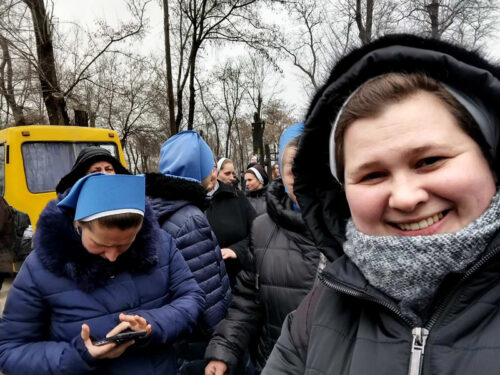
Nuns from the Order of St. Basil the Great are pictured Feb. 22, 2022, during a pilgrimage in Zaporizhzhia, Ukraine, just hours ahead of a Russian invasion.
Yet amid a fast-moving and fluid situation, Sister Murashko said through “a special grace of God” she “feels very calm.”
“We feel peace here,” she said. “We do not want to move from here; we want to help people and stay with them as long and as much as we can.”
Area residents are grateful for that support, she said, especially one neighbor who is eight months pregnant and advised by her doctor not to travel.
Besides, said Sister Murashko, “in the west (of Ukraine), people are not safer than they are here.”
In particular, eastern Ukraine has become all too accustomed to conflict as part of what Archbishop Borys Gudziak and fellow Ukrainian Catholic bishops in the U.S. recently called “an eight-year Kremlin-led war,” which began with Russia’s 2014 annexation of Ukraine’s Crimean Peninsula.
The same year, Russian-backed separatists proclaimed “people’s republics” in the eastern regions of Donetsk and Luhansk, together known as the Donbas.
That move came just 23 years after Ukraine gained independence following the collapse of the Soviet Union, of which it had been a part.
Memories of oppression under Soviet communism were close at hand for Basilian Sister Anna Andrusiv, whose monastery is in Lviv, in Western Ukraine.
Although born in 1988, she “felt in her heart” a unity with long-deceased sisters who hid in the same convent basement during the German occupation of Ukraine in World War II.
Her own grandmother had vivid memories of hardship, deprivation and a constant fear of “saying what you were thinking,” which could result in being sent “to Siberia,” she said.
Sister Andrusiv said she and some two dozen fellow religious — some of whom are up to 90 years old — have their emergency bags packed “in case we are bombed,” with at least three days’ supplies of “food, water warm clothes and medicine” as well as important documents.
At the same time, she and her companions said they were unafraid.
“We want you to know we are just waiting. If it’s going to happen, it will be hard, but we can take it,” she said. “We just want you to know that it’s not from us, this war. It’s like somebody came to our home and wanted to take it, and we will fight back, all of us. All of us will.”
A recent pilgrimage of men and women religious, which concluded in eastern Ukraine just hours ahead of the invasion, has provided renewed spiritual energy for the days ahead, said Sister Murashko.
“We were walking on the main street (of the town) and the people were crossing themselves … and making bows to the crucifix,” she said. “They came to us and gave us strength to serve and … to continue our mission here, so we cannot want to go anywhere else.”
Christian is a senior content producer for CatholicPhilly.com, the news website of the Archdiocese of Philadelphia.
Currents News Staff
After a stop in Poland, Cardinal Konrad Krajewski reached in Lviv, Ukraine. He says refugees are moved to tears when he tells them that he comes on behalf of the Pope.
He also met with Archbishop Sviatoslav Shevchuk, head of the Ukrainian Greek Catholic Church.
From Hungary, Cardinal Michael Czerny crossed the border into Ukraine as well. He traveled by car.
Before leaving, he visited several centers in Hungary that are taking in refugees. Just as the Pope did last Sunday, he thanked the journalists there for their work.
In Ukraine, he met with leaders of different Christian rites, including non-Catholics.
But perhaps the most powerful scenes were the images of war shown to the cardinals by refugees. These are the memories they take with them as they flee their home country.