This site uses cookies to store information on your computer. By using this site, you consent to the placement and use of these cookies. Read our Privacy Policy to learn more.
ACCEPT
As the faithful gather in the Oratory Church of St. Boniface in Downtown Brooklyn, some find they are celebrating midday Mass in the dark.
A veil of shadow covers a corner of the church: construction on a new building next door has blocked the natural light.
“Those three windows there literally right now are completely dark, because behind them is corrugated steel. It looks like a garage door. It’s part of the whole New York City fire code,” explained the administrative vicar at the Oratory Church of St Boniface, Father Anthony Andreassi, CO.
It’s a disappointing sight for people in the pews who regularly admire the view.
“I was a little upset because every church has its art and being part of this church, it made me feel very uncomfortable that there is three windows dark. You cannot see the art at all,” said parishioner, Robert.
“I think it’s a shame you can’t see them, and these over here look so beautiful,” said parishioner, John Baldo.
At one point in time, the church was the tallest building in the neighborhood but now it’s dwarfed by towering skyscrapers.
It was built in 1872, as German immigrants wanted a parish in that particular part of Brooklyn.
“Many of the stained glass windows in here either have German scripture verses in them or the saints depicted had a particular attachment to German immigrants at that time. Of course, the church is dedicated to Saint Boniface, who was a great missionary who was really English, but he was a monk bishop who brought the faith to Germany,” said Father Andreassi, CO.
There is a light at the end of this tunnel, however: the project next door is on parish land, meaning the church will be able to use the bottom four floors for parish space and Catholic campus ministry.
“We keep reminding them: ‘Just give us a little more time,'” Father Andreassi told Currents News. “There’s a wonderful project that’s happening on the other side of the windows, and then we’re going to be able to bring light back to the windows.”
The church has had conversations with lighting experts about installing backlighting to the windows once construction is completed, in order to make them even more vibrant.
Campers and alumni from Camp Mystic, an all-girls Christian sleep away camp, are coming together to mourn and comfort each other following the deadly flash floods in Texas.
Tens of thousands of U.S. residents could face deportation: the Trump administration will be terminating temporary protected status for migrants from Honduras and Nicaragua.
The Diocese of Brooklyn is well-equipped to serve migrants in New York City, including seven men who have been newly ordained as priests.
(OSV News) – Texas Gov. Gregg Abbott declared Sunday, July 6 a day of prayer throughout the state, as the death toll from catastrophic flooding July 4 has now risen to more than 100 people as of July 8, including children in Kerr County. More than 40 people remain missing. This is a developing story.
A search remains underway for girls and a camp counselor still missing from Camp Mystic, a Christian, girls-only sleep away camp in Hunt, Texas. The camp’s director, Richard “Dick” Eastland, perished while trying to save campers from the deluge.
“Texans are known for their faith, strength, and resilience,” said Abbott, who is Catholic. “Even as floodwaters raged, neighbors rushed in to rescue, comfort, and bring hope. In times of loss, we turn to God for comfort, healing, and strength. I urge every Texan to join me in prayer this Sunday – for the lives lost, for those still missing, for the recovery of our communities, and for the safety of those on the front lines.”
The state received prayers from Rome as Pope Leo XIV spoke of the horrific events at his Sunday Angelus talk.
“I would like to express sincere condolences to all the families who have lost loved ones, in particular their daughters, who were at the summer camp, in the disaster caused by flooding of the Guadalupe River in Texas in the United States,” he said, adding, “We pray for them.”
The Archdiocese of San Antonio asked for the intercession of St. Anthony of Padua for “our communities in need.” In a social media post, it prayed for “families who have lost loved ones, homes, or livelihoods due to the recent flooding in the Hill Country, that they may find strength and healing through Christ.”
The Archdiocese of Galveston-Houston posted prayers in English and Spanish for those affected by the flooding saying, “in this time of uncertainty and sorrow, we unite ourselves to the Good Shepherd and ask for His protection and comfort over the victims, families, and first responders. We entrust the souls of those who passed to the mercy of Our Heavenly Father, and we seek the intercession of Our Lady of Perpetual Help, imploring her assistance in the rescue of those still missing.”
Among the dead were two sisters from St. Rita’s Catholic Church in Dallas, Blair and Brooke Harber, 13 and 11 years old. The girls were camping with their grandparents along the Guadalupe River. According to a GoFundMe for the family, the girls were known to love religion class and had their rosaries with them on the trip. The sisters’ bodies were found 15 miles away with their hands clasped together.
The girls’ parents were in a separate cabin and were able to survive the flood, but their grandparents were still missing as of July 7.
“Please keep the Harber family in your prayers during this time of profound grief. May our faith, our love, and our St. Rita community be a source of strength and comfort in the days ahead,” St. Rita’s pastor, Father Joshua J. Whitfield, said in a message to the church community.
Notre Dame Catholic Church in Kerrville, where Archbishop Gustavo García-Siller of San Antonio celebrated a July 6 Mass following the tragedy, has been a hub of both material and spiritual support for the devastated community. The outpouring of support has been so great that the church has paused collection of food, water, clothes and cleaning supplies, although financial donations are still being accepted.
“We were overwhelmed by the amount of support that has poured in over the last two days,” the parish said in a July 6 Facebook post, which included pictures of dozens of cases of bottled water, paper products, shelf-stable food, diapers and cleaning supplies.
The parish has also announced a nightly rosary, which will be prayed July 7-11 at 6:30 p.m., for flood victims, families still searching for loved ones, first responders and volunteers.
“All are invited, parishioner or not, Catholic or not, to join us” in prayer, said the parish.
More than 80 people in Texas, including young girls from Camp Mystic, a Christian summer camp, have died in flash floods.
As search and rescue efforts continue, Pope Leo XIV is praying for the victims of the natural disaster.
Archbishop Gustavo García-Siller of San Antonio has a message of hope for those affected by the floods, saying the Catholic community is listening to the cries of the suffering.
(OSV News) – As many in Kerrville, Texas, rushed to find news of missing loved ones or grappled with losing their homes following catastrophic flooding, San Antonio Archbishop Gustavo García-Siller was among the faith leaders present to offer prayers and support.
OSV News spoke with the archbishop July 5 about his efforts to respond to the devastation left by the historic flooding that has left at least 80 dead, including campers and counselors from Camp Mystic, a Christian summer camp in Hunt, Texas.
The archbishop went to Kerrville July 4 and spoke with families affected by the flooding, including one mother whose 9-year-old daughter was still missing from Camp Mystic. He visited a designated site serving the families searching for their loved ones, and he encountered many people there who were scared and who welcomed prayers as they sought answers.
The archbishop also visited Notre Dame Catholic Church in Kerrville, “one of four sites that the city has selected to be centers for refuge, for care, for help,” he said.
“Catholic Charities was present, bringing food, clothes, hygiene articles, water,” Archbishop García-Siller told OSV News, adding that they “were able to place cots there because families have been evacuated and some families also have lost their house or their trailer so they will need a place to stay.”
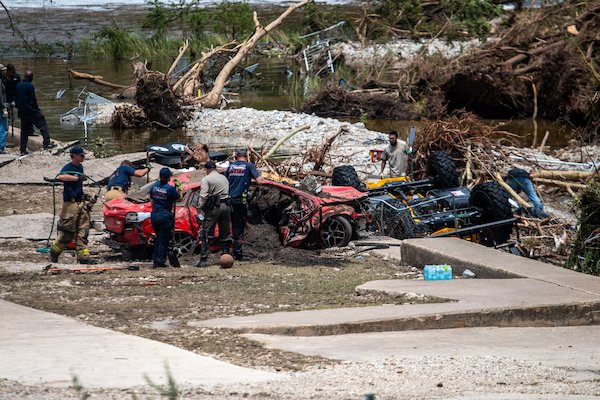
First responders attend to a vehicle pulled from the water in the aftermath of deadly flooding in Kerrville, Texas, July 6, 2025. At least 82 people are dead and at least 41 more are missing after devastating flash floods slammed the Texas Hill Country, with water rescues taking place along the Guadalupe River, which rose rapidly early July 4 to the height of a two-story building. Among the missing were almost a dozen from Camp Mystic in Kerr County, a children’s summer camp, officials said July 6. (Photo: OSV News/Sergio Flores, Reuters)
Driving to the area, the archbishop asked himself what God was “asking of me in this situation, so that I would be useful,” to those facing fear and loss, but he said his focus quickly changed when he arrived from wondering how he could best be helpful to simply being present to those who were suffering.
He said in these situations, it’s important to “let yourself be touched with the reality” of the moment and “just to be” with people and attentive to their needs as well as offering prayer.
“In my case, it’s calling upon the Holy Spirit to guide me to know how to be present, not just to them in general, but to this individual,” he said.
“A lot of young parents were there, very young and they were coming from different places too,” he said. “This is not an issue just for the San Antonio Archdiocese, which is part of it, but no, there were people from Houston, from Austin, from other states.”
He added that the flooding will have a long-lasting impact on the community.
“I was very involved with what happened in Uvalde, Texas, with the killing of 19 children and two teachers, three years ago, and we’re still dealing with that,” he said. Following the floods, the archbishop said despite the cause being different, “the fact is the same: lives are missing,” and “the families are going through a lot.”
Archbishop García-Siller celebrated Mass on July 6 at 11 a.m. at Notre Dame Church, which he sees as an opportunity to be with the people and accompany them as they continue to deal with the impact of the lives and homes lost.
In these moments, he said, it is important “to recognize that God wants to work in us, in this very difficult time,” and we should “open ourselves to believe — that will lead us in time to have hope.” In the meantime, he said, he said that every person wanting to help can “make a choice to love.”
A walkway is blocked by fallen trees following deadly flooding in Kerrville, Texas, on July 5, 2025. (Photo: OSV News/Sergio Flores, via Reuters)
He said that while the area has plenty of resources for the time being, he encouraged the faithful to empathize with and pray for those who so quickly and unexpectedly lost their homes and family members.
The archbishop said there aren’t easy answers or quick fixes for tragic situations like “the family who loses their child at a young age and especially like this, totally unexpected.”
“That’s why we are called to do something, to be present and we find out with God’s grace how we are contributing for the well-being of the people,” he said, adding that there are “many other aspects besides the material needs that are being addressed, and we’ll continue addressing.”
Archbishop García-Siller said people “should not be indifferent” when they hear of such tragedies. And he praised those who want to help and asked that people use this as an opportunity to better understand the suffering of others, adding “it is a contribution if they pray.”
Vehicles sit damaged after deadly flooding in Kerrville, Texas, on July 5, 2025. (Photo: OSV News/Sergio Flores, via Reuters)
After years of formation, seven men entered the Co-Cathedral of St Joseph as deacons and prepared to leave as priests in the Diocese of Brooklyn.
Brooklyn Bishop Robert Brennan led the men in the Sacrament of Holy Orders on Saturday, June 28.
Where prostrating before the altar they offered their lives in service to the people of God.
“I’m giving it all to God and just laying down my life just as Christ laid his, and I’m no longer the owner of my life at this point. It belongs now to the church, to Christ,” said Father Callistus Ibeh, a newly ordained priest.
“When I lay down on the floor, that is the death of Paulo Salazar. And when I rise up, it’s Father Paulo. And to go out and to bless His people and to give them the nourishment of the food for their souls,” said Father Paulo Salazar, a newly ordained priest.
They come from different countries and speak a multitude of languages, but the Brooklyn shepherd says their one similarity is their devotion to Christ.
“These are very talented men, but they’re also generous, they bring a vast variety of experiences and gifts, and they’re going to be putting those gifts to work,” said Bishop Brennan.
Then the seven reached the moment they were all waiting for: Bishop Brennan placed his hands on their head followed by the priests of the diocese, officially marking them as ordained priests.
“Now I’m moving on to this next life. Not completely sure where our Lord is going to take me, but I’m very confident in Him because of all the blessings of graces He’s brought to me into my life, through so many people and through certain prayers and intercession,” said Father Robert Ruggiero.
“To have a moment to pray and to really surrender, to hold on to God and to give myself completely to Him,” was important, Father Alvaro Moralez Sanchez told Currents News.
Their hands, which were anointed during the Mass, will lead countless other faithful throughout Brooklyn and Queens through the sacraments.
“I’m just very happy, genuinely very, very happy,” said Father Benoit Chavanne, “for the very reason that it’s through the ministry and through the hands that we will be consecrating the Host and giving the Sacrament of Confession, too.”
After the Ordination Mass ended, each one spent time blessing loved ones.
“Blessing the people through me because I’m an instrument of God, and I want to be an instrument for the faithful, to encourage them to to praise the Lord, to give thanks to Him, and to be blessed by him,” Father Juan Herreratold Currents News following his ordination.
As they prepare for their assignments, each one is ready to begin their ministry.
“I want to be involved a lot with the youth so they can think about vocation and they might have the call. But sometimes nobody talks to them about the vocation. So I want to spend some time getting to know people,” said Father Gerardo Tlatelpa.
They are spreading the Word of God across the Diocese of Brooklyn.
The crack of a bat and cheers from the sidelines could be heard as the annual “Collars vs Scholars” baseball game kicked off in Coney Island, home of the New York Mets’ AAA baseball team the Brooklyn Cyclones, on Wednesday, June 25.
Every year, priests and principals take the field at Maimonides Park for Catholic Schools Night, an event run by the Catholic Telemedia Network(CTN). The organization is part of DeSales Media Group, the parent company of NET-TV, to mark the end of the school year and the start of summer. in the Diocese of Brooklyn.
“We know last year was a blowout. But I’ve heard that the collars have been practicing a lot, and we are expecting a very close game this year,” Chris Scharbach, the principal of St. Francis DeSales Catholic Academy in Queens, told Currents News leading up to the game.
“A closer game, but hopefully we still pull out a win. We’re still going to win,” hoped Associate Superintendent of Diocese of Brooklyn Schools, John O’Brien.
“It’s the end of the year to celebrate a great year, and it’s really one of the true events where all different people from the diocese get to meet and go together and celebrate the end of the year,” Laura Hickey of CTN added.
The score for this year’s game was stacked with the scholars having won three games, and the collars two throughout the years, though the priests went onto the field with a positive attitude.
“We got our team back together. It’s been a couple of years where everyone has been able to play. But everyone’s here this year. and we’re down two games to three, so it’s an elimination game here,” Director of Vocations for the Diocese of Brooklyn, Father Chris Bethge, told Currents News before his team hit the mound.
The principals furthered their lead, winning 4 to 2. Still, there was no bad blood between the teams.
“We are happy to have fun, it’s a hot day by the way, but we have fun. It was good always to bring God to the field,” said Father Elvin Torres, the parochial vicar at St. Sebastian Church in Queens.
“It makes me feel great inside that I get to work and play with the clergy and fellow principals,” said St. Athanasius Catholic Academy principal, Gina Auricchio.
For the Brooklyn school’s principal and for all involved, Catholic Schools Night isn’t about the game: it’s about the kids.
Valedictorians and salutatorians of Diocese of Brooklyn Catholic school were the MVPs of the game as Brooklyn Bishop Robert Brennan honored them for their hard work.
The students said they were able to achieve so much because they were in Catholic classrooms.
“Well, I, of course, credit myself to my mindset, God and my environment, of course,” said Pria Moses, the valedictorian at Blessed Sacrament Catholic Academy in Brooklyn.
“I like that we have an option to learn a lot about our faith, because I know in public schools they don’t have the opportunity to learn as much as we do,” added Emmett McLoughlin, the salutatorian at Holy Child Jesus Catholic Academy in Queens.
Bishop Brennan said this game also helps bring some faith to the outfield.
“It’s showing that faith connects to real life, showing that faith is part of even the fun that we have,” he told Currents News. “It’s something that ties us together, and it gives greater joy to fun events like this. But also we’re realists: our faith gives us strength in times of sorrow, times, of worry ,in times of anxiety.”
Attendees of Catholic Schools Night also got a commemorative bobble head of Associate Superintendent John O’Brien and Principal Chris Scharbach.
This special edition of Currents News introduces you to the seven deacons who will be ordained priests in the Diocese of Brooklyn on Saturday, June 28, 2025, at 11 a.m. at the Co-Cathedral of St. Joseph.
Here are some of the holy men the special will feature:
– Deacon Robert Ruggiero is the oldest in this year’s ordination class. He took his time discerning the call, but his age could be an advantage.
– Deacon Benoit Chavanne may be thousands of miles away from where he grew up in France, but he says he feels right at home in the Diocese of Brooklyn.
– Deacon Alvaro Morales Sanchez thought he found his calling under the hood of a car, but God had other plans for this former diesel mechanic.
– Deacon Gerardo Tlatelpa went from serving food to serving the Lord – he gave up his day job after going on retreat.
It’s a match six years in the making on June 25, 2025: the Scholars vs Collars baseball game at Maimonides Park, home of the Mets AAA team, the Coney Island Brooklyn Cyclones.
The much anticipated game is a fan favorite for Catholic school students in Brooklyn and Queens, who are the center of the Catholic Schools Night celebration during the June 25 Cyclones game.
Currents News is on the field before the bats start swinging.
Principals and priests are taking to the field for Catholic Schools Night at Maimonides Park in Coney Island, celebrating students from across the Diocese of Brooklyn.
Three longtime Catholic school teachers were honored at Our Lady Queen of Martyrs in Queens for decades of dedication and service to generations of students.
One woman is making a difference every day at St. Stanislaus Kostka Church in Maspeth through her tireless volunteer work — you’ll meet her in this installment of “Pulse of the Parish.”